
In the modern era of post-transplantation cyclophosphamide (PTCy), clinicians frequently face a choice between the two most common mismatched donor options: haploidentical donors and mismatched unrelated donors (MMUD) [1]. While PTCy attenuates the risks of Human Leukocyte Antigen (HLA) disparity, [2, 3] it shifts the decision-making calculus toward non-HLA factors like donor age. However, the prevailing “younger is better” maxim often drives algorithms to prioritize younger donors regardless of donor type, potentially causing unnecessary delays. Current evidence regarding the specific impact and the absolute magnitude of donor age in the haploidentical versus MMUD setting is conflicting, with disparate age thresholds and inconsistent conclusions regarding survival and non-relapse mortality (NRM). [4,5,6,7,8,9,10,11,12,13] Moreover, emerging data suggest that the impact of donor age is non-linear and context-dependent [14]implying that the arbitrary dichotomizations inherent to conventional regression models may be insufficient to capture these complex dynamics. To address this, we applied multimodal machine learning techniques to a Center for International Blood and Marrow Transplant Research cohort to quantify the precise association of donor age with outcomes after haploidentical and MMUD transplantation.
We analyzed 5143 adult patients with acute leukemia or myelodysplastic syndromes who underwent first hematopoietic cell transplantation (HCT) with PTCy between 2017 and 2021 using either a haploidentical donor (n = 4258) or an MMUD (n = 885). The study was conducted in accordance with the Declaration of Helsinki and was approved by the Institutional Review Board (2025-0916), which provided waiver of informed consent.
We employed Random Survival Forests (RSF) to capture non-linear interactions without pre-specification, developing separate models for haploidentical and MMUD cohorts. Standard and cause-specific RSF models were used for overall survival (OS) and competing risks (NRM/relapse), respectively. To ensure interpretability, we utilized Partial Dependence Plots and Accumulated Local Effects. These visualizations depict the models’ learned predictive surfaces based on observed data rather than strict causal effects; to mitigate this limitation and control for confounding, we validated findings using Inverse Probability of Treatment Weighting (IPTW) and bootstrapped elastic net Cox models. Clinical impact was quantified using Restricted Mean Survival Time (RMST) and per-patient counterfactual analysis. Full methodological details, including variable selection, imputation, and model calibration, are provided in the Supplementary Appendix.
The cohort demographics reflected standard practice: unrelated donors were significantly younger than haploidentical donors (median 28 vs. 35 years, p < 0.001). The MMUD cohort comprised a higher proportion of female recipients (54% vs. 40%, p < 0.001) and patients with a higher HCT-Comorbidity Index (≥3) (52% vs. 47%, p = 0.004). The two cohorts were balanced with respect to disease (p = 0.14), graft type (p = 0.45), and conditioning (p = 0.28). Median follow-up was approximately 37 months in both groups (Table 1).
To assess potential heterogeneity within the MMUD cohort, we performed an exploratory analysis of OS stratified by HLA-mismatch [7/8-HLA (n = 817) vs 6/8-HLA (n = 51) vs 5/8-HLA (n = 17)]. Acknowledging the small sample sizes of the subgroups, the analysis showed no significant difference, p = 0.73 (Fig. S1). Therefore, the MMUD was treated as a single group for subsequent analyses. Figure S2 illustrates Kaplan–Meier plot comparing OS between MMUD and haploidentical groups. Detailed survival probabilities and estimates of NRM, relapse, systemic immunosuppressive therapy (IST)-requiring chronic GVHD and grade III-IV acute GVHD are provided in Table S1.
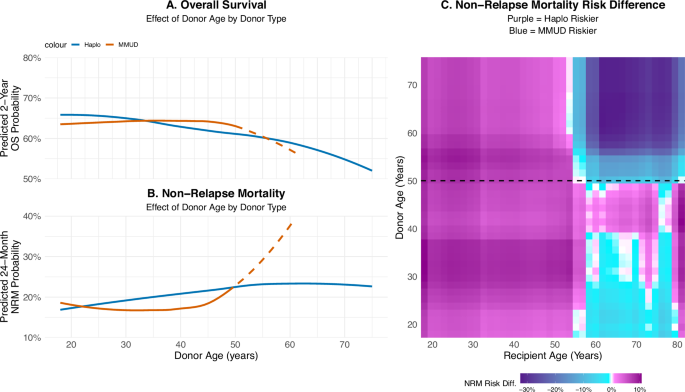
Our primary RSF analysis revealed that the relationship between donor age and OS is non-linear and differs fundamentally by donor type (Fig. 1A). For haploidentical recipients, we observed a consistent, monotonic decline in survival with increasing donor age. In contrast, the MMUD platform appeared less sensitive to donor age, with a flatter risk profile observed for donors up to 50 years old, with a steep decline projected after age 50; this latter finding is likely an artifact of data sparsity (n = 22 with MMUD > 50 years).
The figure illustrates the non-linear, donor-type-specific relationship between donor age and clinical outcomes, derived from calibrated Random Survival Forest models. A Overall Survival and B Non-Relapse Mortality: Partial Dependence Plots displaying the predicted probability of 2-year overall survival and non-relapse mortality as a function of donor age. Curves are stratified by donor type: Haploidentical (blue) and Mismatched Unrelated Donor (MMUD, orange). Solid lines represent estimates within the common data range; dashed lines indicate regions of data sparsity (specifically MMUD donors >50 years) where projections should be interpreted with caution. C NRM Risk Difference Heatmap: Visualizes the absolute difference in predicted 24-month NRM risk between the two platforms (calculated as Haploidentical Risk minus MMUD Risk) across the joint distribution of recipient and donor ages. Purple regions indicate scenarios where the Haploidentical platform is associated with higher predicted risk, while Blue/Cyan regions indicate scenarios where the MMUD platform is associated with higher predicted risk. The horizontal dashed line at donor age 50 marks the threshold of data sparsity for MMUD donors.
Critically, while “younger” was directionally superior, the absolute magnitude of the survival penalty for older donors was modest. Using an 18-year-old donor as the baseline, a haploidentical donor’s age had to reach 42 years to be associated with a mere 10-day loss in 2-year restricted mean survival time. For MMUDs, this 10-day loss threshold was not projected until age 55, although the estimates for unrelated donors aged >50 must be interpreted with caution.
This survival difference was driven primarily by NRM (Fig. 1B), as donor age showed negligible association with relapse risk across both platforms (Fig. S3). Accumulated Local Effects analyses confirmed distinct marginal risk profiles: a monotonic increase for haploidentical donors versus a threshold-dependent rise after age 50 for MMUDs (Fig. S4). To compare NRM risk profiles, we generated a ‘difference heatmap’ subtracting MMUD-predicted NRM from haploidentical-predicted NRM. The heatmap revealed recipient age as a critical effect modifier (Fig. 1C). For recipients up to approximately 55 years, the haploidentical platform was consistently associated with a 2-10% higher NRM risk. Conversely, for older recipients, the dynamic inverted: MMUDs carried higher risk, particularly with older donors—though estimates for unrelated donors >50 years are likely an artifact of data sparsity. Counterfactual simulations confirmed this age-dependent trade-off, showing that swapping to an MMUD was predicted to reduce NRM for recipients younger than approximately 55 years but increase it for older patients (Fig. S5a–c).
Next, we investigated whether optimal donor choice depends on a patient’s inherent NRM risk. We established a donor-agnostic baseline risk score and stratified the cohort into quartiles (Table S2, Fig. S6). This revealed distinct clinical constellations at the extremes: the lowest-risk quartile (Q1) comprised younger, fit patients with low-risk disease, whereas the highest-risk quartile (Q4) was defined by older age, high comorbidity burden, and high-risk disease biology. This stratification exposed a striking ‘inversion of benefit.’ For the younger, fitter constellations (Q1–Q3), the MMUD platform was consistently predicted to be superior, associated with median NRM risk reductions of 2.3–5.3%. Conversely, for the high-risk Q4 constellation, the relationship inverted: the haploidentical platform was the favorable choice, with models predicting a median 4.4% (3.0–5.2%) risk increase had these patients received an MMUD.
We validated these findings using IPTW and bootstrapped elastic net models. These frameworks confirmed a significant, non-linear interaction between donor age and donor type for OS (IPTW p = 0.009; Elastic Net 97.2% inclusion frequency) [Tables S3–S4, Fig. S7] and NRM (94.2% inclusion) [Table S5, Fig. S8]. Conversely, analyses for relapse consistently yielded null findings [Table S6]. For GVHD, no interaction emerged; rather, older donor age proved to be an independent, monotonic risk factor for both acute and chronic GVHD [Tables S7–S8, Fig. S9].
Regarding donor-specific factors beyond age, these models identified cytomegalovirus mismatch (specifically Donor-negative/Recipient-positive) as a significant independent predictor of inferior OS (Hazard Ratio (HR) 1.18, 95% confidence interval (CI) 1.06–1.32). Additionally, female-to-male sex mismatch was identified as a stable driver of acute GVHD (HR 1.28, 95% CI 1.00–1.66) and chronic GVHD (HR 1.13, 95% CI 1.00–1.32). Causes of death were comparable between groups, led by relapse (~30%) and infections (10–15%) [Table S9].
Clinically, our study provides a quantitative counterweight to the risks of search-related delays. The Blood and Marrow Transplant Clinical Trials Network 1702 trial demonstrated that one-third of eligible patients failed to proceed to HCT, primarily due to clinical deterioration during the search [15]. Our work addresses the immediate subsequent question: once a haploidentical or an MMUD is identified as the likely source, how should a clinician weigh donor characteristics like donor age? By quantifying the precise influence of donor age, and its differential association in the MMUD setting, we provide the granular, evidence-based guidance needed to move from equitable access to optimized outcomes.
Our findings also underscore that donor selection is a multi-dimensional decision that extends beyond survival. A critical finding is that increasing donor age was independently associated with higher GVHD risk across both platforms, reinforcing ‘younger is better’ for morbidity despite its limited survival impact. This creates a distinct trade-off: the tangible GVHD reduction with a younger donor must be weighed against the dangers of treatment delay. Furthermore, as the field evolves, the integration of novel agents such as abatacept or ruxolitinib with the PTCy platform (ClinicalTrials.gov: NCT06859424) may further mitigate the donor age-related risk of GVHD we observed.
Our study has limitations. Our finding that the MMUD platform is less sensitive to advancing donor age is mostly constrained to unrelated donors younger than 50. Additionally, aggregating non-White recipients masks heterogeneity, and residual confounding remains possible despite weighting. To ensure the robustness and broader applicability of these findings, validation in independent international registries that encompass diverse racial and ethnic populations will be essential.
In conclusion, our findings suggest that instead of treating the “younger is better” maxim as an absolute rule, the optimal donor choice is governed by a nuanced, non-linear interaction between donor age and donor type. While younger donor age remains an important consideration for reducing the risk of GVHD, delaying transplantation in the pursuit of a marginally “younger” or “more ideal” donor must be carefully weighed against the well-documented risks of treatment delay.

