
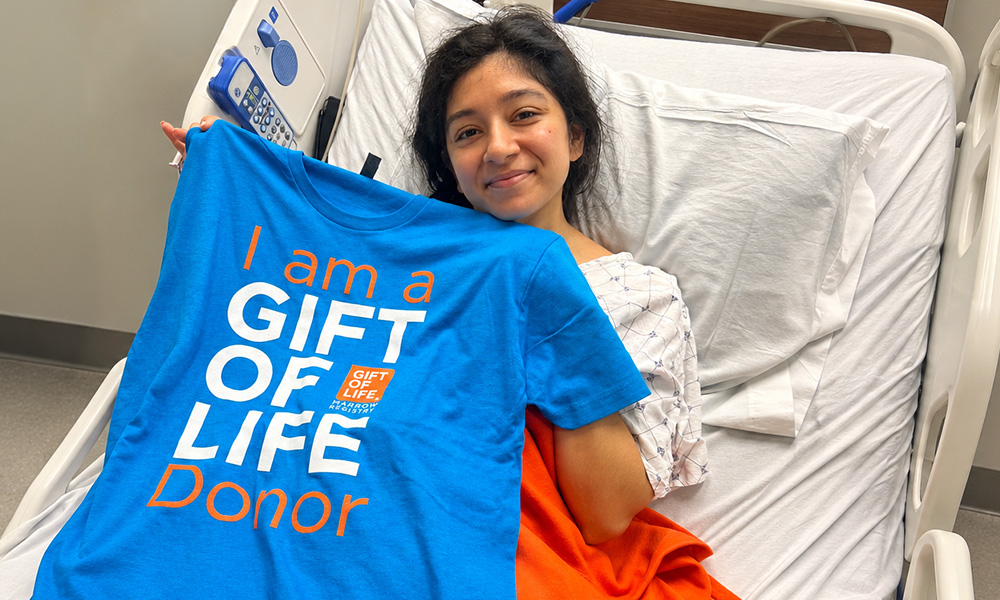
Saumya Khanna was sitting in a parking garage when the phone call and question came.
Would she donate bone marrow to a stranger in need?
Khanna knew her decision could change the course of someone’s life. When she was nine years old, her grandfather died of leukemia in India. A little over a decade later, in the U.S., her father was diagnosed with the same disease. Khanna’s bone marrow matched her father’s, so she donated stem cells to him, which led to his recovery.
“In this case, one person really does make a difference,” Khanna said. “If one person with that genetic combination is not there, or something falls through and they’re not able to donate, you go to the next person until the end of the list. Every person really does matter.”
That realization led Khanna to join a national registry for bone marrow transplants. Years later, it brought her to the parking-garage phone call and, eventually, a donation procedure at Georgetown University in Washington, D.C. This time, the recipient was a child she never met.
Under general anesthesia, doctors used a needle to extract marrow from Khanna’s pelvic bone. She experienced some stiffness afterward but said the health risks were minimal and she felt fully recovered within weeks.
The procedure gave physical form to an idea that also drives Khanna’s work as a Ph.D. in Public Policy and Management (PPM) student at the USC Price School of Public Policy: Decisions can transform people’s health, whether the impact is immediate and personal – like her bone marrow donation – or unfolds indirectly through research and policy.
“I was so grateful that the genetic combination I received from my grandfather and father was allowing me donate to this child,” Khanna said.
How healthcare systems shape lives
Her family’s experience with leukemia showed her how a person’s location, insurance, proximity to a hospital and access to medical expertise can shape not only health outcomes, but the experience of illness itself. Her father received treatment at an academic hospital, where Khanna’s family could consult specialists and remain nearby while he was immunocompromised. By contrast, her grandfather was in a different hospital, in a different system, with different protocols. Khanna realized that the system itself can shape the patient experience.
“People are often born in the health care system and may die in it,” Khanna said. “But you can also interact with it at these very crucial moments in your life — and you deal with changes in health, suffering, and you can also find joy and realize truths about life.”
Those experiences convinced Khanna that health is a foundation for everything else people hope to do, from pursuing a career to following their passion. They also prompted her to study why healthcare systems sometimes help patients navigate difficult moments — and sometimes create additional obstacles.
Studying automatic enrollment in Medicare Part D
At USC Price, Khanna studies behavioral science and consumer decision-making in health insurance markets. Her dissertation focuses on automatic enrollment in Medicare Part D, the portion of Medicare that provides prescription drug coverage through private plans.
Beneficiaries may have numerous plans available in their region, each with different costs and coverage. Finding the best option can require consumers to compare plans against the medications they take. Yet research has shown that people do not always choose the plan that would benefit them most. Some remain in the same plan year after year even if a better plan is available, a behavior researchers call inertia, Khanna said. Others may struggle with choice overload or the administrative work required to enroll at all.
Khanna is examining whether people choose plans that match their health care needs. She is also studying consumer behavior once they are no longer automatically enrolled in a plan.
“Saumya is committed to looking after others whether in her research or private life,” said Professor Jason Doctor, who is Khanna’s dissertation chair. “Her research asks if there is a way to help others choose a health plan that best meets their needs, a question that is often neglected. And in her personal life she has made sacrifices to save the lives of those in dire situations. Through her bone marrow donation, she has enriched the life of someone and their family; that type of gift is truly precious.”
The effects of health policy research can be difficult to see. Unlike a marrow donation transported to a waiting patient the same day, a study may take years and influence decisions through a complicated interaction among researchers, policymakers and other groups. Khanna said donating marrow reminded her that people remain on the other end of that more abstract policy work.
“People do read research, policy votes do matter, and organizing does matter,” Khanna said. “Even if it feels more abstract on a systems level, engagement and involvement are very important.”
Khanna may have the opportunity to meet the child who received her marrow after a year, if both sides consent. For now, she does not know what happened after the donation. She had to accept that she could make the choice to help without controlling the outcome — a lesson that applies to policy work, too.
“You just have to do your best,” Khanna said. “You won’t know what’s going to happen after that, and you have to find peace with that fact.”

