
Table of Contents
Good morning! This is Tanuzaishe 🦝💊
How is everyone spending this long weekend?
In the previous article, I talked about the basics of what dialysis treatment is.It was that one where, despite being a pharmacist’s article, almost no talk of medicine appeared lol
Following up on that, this time,
I would like to talk about “How should we think about medication for patients undergoing dialysis?”
When a patient says at the pharmacy, “I’m on dialysis,” what is the first thing you think about?
“Since their kidneys are bad, should I just reduce the dose? 💦”
“If the medicine is removed by dialysis, do they need more? 💦”
“Should they just take everything after dialysis is finished? 💦”
Yeah. I get it, I really do.
Should I reduce it or increase it? Which one is it? 😇
Here, there is something I want you to grasp first.
In times like these,
you should think of “the difficulty of medicine leaving through the kidneys” and “the removal of medicine by dialysis” as separate issues.
When you organize these two points, the way you view prescriptions will change.
So, this time, I will mainly explain this using the context of maintenance hemodialysis and peritoneal dialysis performed on an outpatient basis.
For continuous blood purification therapyperformed in places like the intensive care unit, let’s not apply these two directly. Because the way of thinking is completely different! (*´ε`*)chu
Today’s article is also brought to you by Tanuzaishe!
Well then, let’s get started!
1. Even if you are on dialysis, kidney function does not return to normal
For drugs excreted by the kidneys, the speed at which they leave the body slows down when kidney function declines. If you continue to use the same amount at the same intervals, the drug may not be sufficiently reduced before the next dose enters, leading to accumulation in the body.
What you want to be careful about here is that you need to check not only the drug itself but also the substances created through metabolism.
Even if the original drug is mainly metabolized in the liver, there are cases where active or toxic metabolites are excreted by the kidneys.You can’t just end it with “It’s liver-metabolized, so it’s safe!” Also, in renal failure, protein binding and drug processing outside the kidneys may change. [1]
Me: “You need to look at not just the exit of the drug, but also its subsequent form (metabolites)!”
Dialysis is a treatment that removes some substances, but it does not process all drugs in the same way as a healthy kidney.
First, start by checking whether the medication can be used for dialysis patients. Begin by confirming the presence of any contraindications, indications, and the appropriate administration method for dialysis patients. [2]
② “Reducing the dose” and “extending the interval” are not the same
There are generally three ways to adjust for when a drug tends to remain in the body. three main ways.
However, even if the average daily dose is the same, the way blood concentration rises and falls is not the same.
Some drugs require “reaching a high concentration,” while others require “maintaining a necessary concentration for a certain period.” Therefore, do not rely on your own judgment to simply “halve the dose” or “take it once every two days”; instead, check the usage instructions for each drug. [1]
Another point is that loading doses to reach the necessary concentration initially and maintenance doses to maintain the concentration thereafter are separate matters.
Loading doses are mainly related to how far the drug spreads in the body, while maintenance doses are mainly related to how much is eliminated from the body.
For example, let’s consider everyone’s favorite (?), levofloxacin.
Levofloxacin is an example of a drug where the initial dose is maintained even if renal function is reduced, and subsequent doses or administration intervals are adjusted. For such drugs, if you mechanically reduce the initial dose simply because of reduced renal function, you may not be able to sufficiently secure the drug concentration required at the start of treatment. Think of the “initially required amount” and the “amount to continue thereafter” separately, and check the recommendations for each drug and the patient’s condition. [1]
I’ll say it again, there is no 250mg daily administration method in the package insert! 🤣
③ Drugs that are easily removed by dialysis have specific characteristics
The next thing to look at is “dialyzability.” In other words, how much of that drug is removed by dialysis.
In hemodialysis, a portion of the drug is removed while blood passes through the dialyzer. In general, drugs with the following characteristics are more easily removed. [1,3]
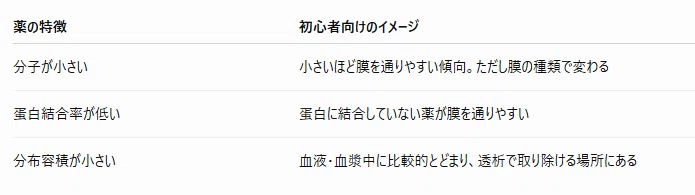
The term “volume of distribution” suddenly makes it feel like a university lecture. Do you remember it? It’s that thing called Vd (Volume of Distribution)!! 🤣
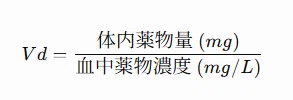
This is not the actual volume of an organ, but an apparent indicator showing how much a drug has spread throughout the body relative to its blood concentration. For drugs that transition widely into tissues, even if you remove the drug from the blood, the percentage that can be removed from the entire body may be small.
Some water-soluble drugs are easily removed by dialysis, but “soluble in water” does not always mean “easily removed.” You also need to look at protein binding and volume of distribution together.
Furthermore, it also changes depending on treatment-side conditions such as the dialysis membrane, blood and dialysate flow rates, dialysis time, and whether it is HD or HDF (hemodiafiltration). With high-flux membranes, drugs with relatively large molecules that were difficult to remove with conventional membranes may also be removed. Do not assume that “it won’t be removed because the molecule is large.” [1]
Visualize based on the properties, and confirm the final decision with the dialysis data for that drug.
This is important. A simple ‘Yes’ for ‘dialyzability’ does not determine the additional dosage.
Me: ‘Ahhh! There are so many, it’s difficult!!!’
You might think that, but for now, just accept that it is what it is.
④ In hemodialysis, confirm ‘when to take it on dialysis days’
If a drug is sufficiently removed by dialysis, administering it immediately before dialysis will result in part of the administered drug being removed during the subsequent dialysis. Therefore, for some drugs, the administration time is adjusted to after dialysis on dialysis days. [1,3]
However, these two things are easy to confuse here.
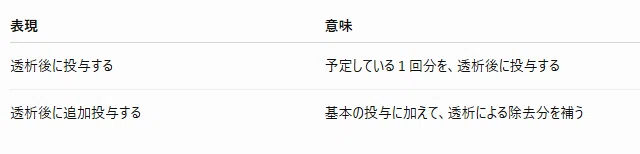
Me: ‘Taking it after and taking it one more time after are different things!’
Now, let’s explain using pregabalin as an example!
Actually, according to the package insert, pregabalin has a description for additional administration after hemodialysis in addition to the daily dose based on renal function. On the other hand, the materials from the Japanese Society of Nephrology Pharmacotherapy note that if a once-daily dose is taken after dialysis on dialysis days, no supplementation is required. However, it is also noted that attention should be paid to the decrease in drug concentration during/after dialysis and the appearance of pain. [2,4]
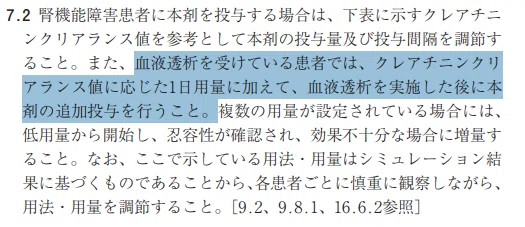
In other words, you cannot simply add a dose by looking only at the additional administration description, nor can you cut the additional amount based solely on a single sentence in the academic society materials. You must confirm the actual administration time, the entire prescription, therapeutic effects, and side effects, and consult with the prescribing physician if a judgment is needed.
Also, just because it says ‘administer after dialysis’ does not necessarily mean ‘administer only on dialysis days.’ Confirm whether it is also used on non-dialysis days and how to handle the interval until the next dialysis.
Especially for pain-related drugs like pregabalin, even if the patient is actually feeling pain after dialysis, medical staff may not notice it if they haven’t conducted a sufficient interview. I wonder how many pharmacists have actually seen a pregabalin prescription with an additional dose after dialysis? This might be because the administration method becomes complicated, but I personally think it’s also because doctors probably don’t consider it much unless there is a strong complaint from the patient regarding pain.
For drugs like this where it is difficult for others to judge the effect such as pain, patient interviews are very important. Therefore, whether or not you know that there are drugs that get removed and lose their effect changes whether you can connect it to asking, ‘Is the patient having any trouble?’
That is precisely why it is important for pharmacists to thoroughly check these areas and provide information as needed✨
⑤ Let’s stop saying ‘everything after on dialysis days’
The reason for considering the timing is not just whether it is removed by dialysis.
For example, phosphate binders are used to suppress the absorption of phosphorus contained in food. According to the electronic package inserts, Kicklin capsules are taken immediately before meals, and Fosrenol OD tablets are taken immediately after meals. [7,8]
If you move these to after dialysis across the board, the timing relative to the meals they are actually intended for may be off. Do not assume that “it’s a phosphorus medication, so it’s all at the same time”; instead, check the usage instructions for each specific formulation and the actual meal times.
For antihypertensive drugs, you need to monitor both the drop in blood pressure during dialysis and blood pressure management during the time they are not on dialysis. Decisions on whether to take medication before dialysis must be made on an individual basis; you cannot simply decide that “because they are a dialysis patient, all morning antihypertensive drugs should be discontinued.” [5]
If systolic blood pressure drops below 90 mmHg during dialysis, or if there is dizziness or nausea associated with a drop in blood pressure, it is a trigger to review not only the antihypertensive drugs but also the ultrafiltration rate and dry weight. This is not a criterion for automatically skipping morning medication. ❶
On the other hand, the 2011 domestic guidelines indicate a pre-dialysis blood pressure of less than 140/90 mmHg at the start of the week as a benchmark for stable patients. However, this assumes there is no hypotension during dialysis and is not a universal goal for everyone. ❷
(This is a benchmark from an old document and is not a value to be applied uniformly to everyone.)At the pharmacy, “How low does it go during dialysis?”, “Are there symptoms at that time?”, and “What is it like at home?” should be confirmed and cross-referenced with the medication instructions from the dialysis facility.
❶ KDIGO Conference Report 2020: pp.862–865
❷ Japanese Society for Dialysis Therapy, Cardiovascular Complication Guidelines 2011: pp.358–359
At the pharmacy, if you ask “What time does dialysis start?”, “When do you eat?”, and “Are there any medications you were instructed to take at the hospital?”, things that cannot be seen from the prescription alone will come to light.
Furthermore, do not let the pharmacy decide to wait until the end of dialysis for medications that need to be started urgently. The timing of the initial dose and subsequent replenishment or adjustments should be decided in consultation with the dialysis facility.
⑥ Peritoneal dialysis does not use the same administration methods as hemodialysis
I have focused on hemodialysis so far, but what about peritoneal dialysis?
Peritoneal dialysis is a treatment that removes substances through the peritoneum. The removal rate of drugs is generally slower than in hemodialysis, but you need to consider removal over a long period of time. Since the impact varies depending on the drug, you cannot simply say that “drugs are not removed in peritoneal dialysis.” [1]
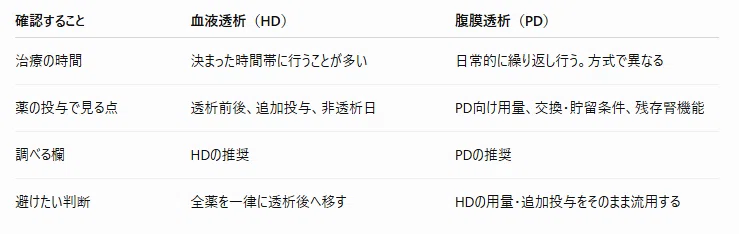
Peritoneal dialysis also includes CAPD, where dialysis fluid is exchanged manually and fluid is usually kept in the abdomen at night, and APD, where it is exchanged by a machine mainly at night. In addition to saying “I am on peritoneal dialysis,” confirm what method is being used. (There are also many types of dialysis fluid!!)
[Supplement] CAPD (Continuous Ambulatory Peritoneal Dialysis) → A method where the patient manually exchanges dialysis fluid during the day. Usually exchanged about 3 to 5 times a day. APD (Automated Peritoneal Dialysis) → A method where dialysis fluid is automatically exchanged using a dedicated machine (automated peritoneal perfusion device). Mainly performed at night while sleeping.
Especially in antibiotic treatment for peritonitis, drugs may be administered into the abdominal cavity, and the route of administration, method of addition to the dialysis fluid, and dwell time are important. The 2022 ISPD guidelines do not recommend applying CAPD antibiotic dosages directly to APD. This is because drug removal may increase in APD, and there is a risk that the necessary concentration cannot be maintained. For intraperitoneal administration, also pay attention to the dwell time required for the drug to be absorbed. [6] This is a discussion regarding antibiotic administration for peritonitis and does not mean that “APD patients should have all medications increased or added.”
This part cannot be judged solely by a dosage reduction table for oral medications. Be careful, as this is a situation where you should confirm the treatment plan of the dialysis facility!
[Aside] There is a “dual-wielding” cephalosporin prescription that beginners still sometimes want to inquire about:
intraperitoneal administration of Cefazolin (CEZ: for Gram-positive bacteria) + Ceftazidime (CAZ: for Gram-negative bacteria including Pseudomonas aeruginosa). If you don’t know anything, it’s something a beginner would want to question when they see it. But this isstill one of the options for “initial treatment before the bacteria are identified” for adult peritoneal dialysis-related peritonitis.
ISPD 2022 recommends covering both (Gram-positive bacteria + Gram-negative bacteria including Pseudomonas aeruginosa). Please remember this if you’d like! [1B: Strong recommendation, moderate evidence]
⑦ “During dialysis” does not mean “zero kidney function”
Some dialysis patients still have residual kidney function. This is called residual renal function.
This is super important!!!! It’s something that must be confirmed at the pharmacy too!!
When considering drug processing, you need to look at “remaining kidney function,” “removal by dialysis,” and “processing in organs other than the kidneys, such as the liver,” all together. [1]
However, you cannot determine the drug excretion capacity based solely on the amount of urine output.
You cannot simply say, “They are still urinating, so a normal dose is fine!” and conversely, you cannot treat everyone under the same conditions just because they are on dialysis.
Also, serum creatinine itself is removed by dialysis. Avoid applying the eGFR shown on lab reports directly to dosage categories for non-dialysis patients, and instead check the administration methods for dialysis patients and evaluate their residual renal function. [1]
Therefore, at the pharmacy, if possible, it is good to ask, How is your urine output compared to before? I often ask about urine volume using containers that are easy to visualize, like, Is it about a small Yakult bottle (around 60mL) or a cupful? I use that to get an idea.
Me: “When you see numbers written down, you want to use them, but take a breath and think about whether it’s okay to use those numbers in the current situation!!”
Also, don’t forget to ask about their weight (*´ε`*) kiss
⑧ Even if the prescription is correct, follow-up is necessary
If it matches the dosage table, you’re done. Everything is A-OK!!
……That is not the case!!🤣
For pregabalin, first check for drowsiness or dizziness.
JSNP materials indicate that even if the dose is reduced according to renal function, dizziness and somnolence are still likely to occur.[2]
Furthermore, for pregabalin, the electronic package insert also mentions side effects of falls and tumbling, as well as warnings regarding falls and fractures in the elderly associated with dizziness, somnolence, and loss of consciousness. A pharmacist who can check “Do you feel unsteady when walking?” or “Have you felt like you might fall?” is one step ahead!😊[4]
Additionally, after starting a new medication or increasing a dose, ask specifically if they have had any complaints like “I’ve been feeling foggy lately,” “It’s hard to walk,” or “Things feel different than usual.” For sudden changes in consciousness, do not assume it is the medication’s fault; prompt contact with a medical institution is necessary. For drugs subject to TDM, where blood concentrations are measured and adjusted, check not only the numerical values but also the time of the last dose, the time of blood collection, and the timing relative to dialysis.[1]
When checking medication information, confirm not only prescription drugs but also injections, OTC drugs, vitamins, minerals, supplements, and actual usage methods. The medication history interview guide published by BC Renal also includes these check items. [9]
At the pharmacy, try expanding that check to include medications administered at the dialysis facility and prescriptions from other hospitals. The medications listed on the pharmacy prescription are not necessarily all the medications the patient is taking. It is reassuring for everyone if you share information thoroughly, also serving as a double-check with the prescribing clinic and the patient’s own account.😊
When you are unsure at the pharmacy, check in this order
It is hard to remember everything at once, so I look at them in this order!!
① What kind of dialysis? Check HD, HDF, PD, day of the week and time, and method if PD.
② Can that drug be used? Check contraindications, indications, and precautions for dialysis patients.
③ What are the dose and interval? Based on electronic package inserts and interview forms, check materials and notes specific to HD/PD.
④ Is it removed by dialysis? Check if a change in administration time or an additional dose is necessary.
⑤ When and how are they taking it? Check for overlap with meals, non-dialysis days, and facility administration.
⑥ Is it working? Are there any problems? Re-evaluate based on efficacy, side effects, and necessary tests.
When the materials you checked differ, do not just compare the numbers and ask “Which one is correct?” but also check the premises, such as the target dialysis conditions, administration time, and whether the description is based on the package insert or expert recommendations. [2]
Medications for dialysis patients cannot be explained simply by “reducing them because the kidneys are bad.” While some drugs remain in the body easily, others are removed by dialysis. That is precisely why you need to consider the dose, interval, and timing together.
Beginners do not need to memorize the dialyzability of every drug from the start.
“For this drug, it might be better to check not just the dose, but also the time it is taken.”
Once you notice that first step, the next things to look into will become clear.
Because you are a pharmacy that can ask patients about their “usual way of taking medication,” there are things you can pick up on. Let’s work on increasing those insights together, little by little 🦝💊
Today’s Tanuzaishi
If you want to check medication dosage during dialysis or dialyzability…
Here are the recommended information sources!!
A tool that can search for renal function dosage information, which is also implemented in the package inserts on Tamanavi, has been implemented by Neko-chan through blood, sweat, and tears (Package inserts are the basics, after all!)
Since we are operating with only 3 people, we are doing our best, but there might be some discrepancies or parts that are hard to read… If that happens, I would be happy if you could quietly let us know…! There are about 12,000 items just in the PMDA-listed drugs!! 😇
(If possible, for a while, I would be super happy if you could check if renal function adjustments are flagged on Tamanavi and then cross-reference them with the package insert… lol)
I would be happy if everyone could help grow Tamanavi together!!
Here is Tamanavi! 🥰
That’s all for today~!
#Pharmacist #PharmacyPharmacist #Dialysis #Hemodialysis #PeritonealDialysis #Pharmacotherapy #PrescriptionAudit #MedicationGuidance #Tamanavi #Tanuzaishi
Reference Materials
[1] Matzke GR, et al. Drug dosing consideration in patients with acute and chronic kidney disease—a clinical update from KDIGO. Kidney International. 2011;80:1122–1137. Refer to the basic concepts of pharmacokinetics and dosage design.
https://kdigo.org/wp-content/uploads/2017/02/KDIGO-DrugDosingReportFinal.pdf
[2] Japanese Society of Nephrology Pharmacotherapy, “List of Drug Dosages Requiring Most Caution in Patients with Reduced Renal Function,” 39th Edition (June 2026). Refer to the HD/PD columns and notes.
https://jsnp.org/files/dosage_recommendations_39_202606.pdf
[3] BC Renal: Pharmacy & Formulary/Dialyze-IHD. Materials for auxiliary research on dialyzability and administration timing for intermittent hemodialysis. Distinguish from domestic approved usage.
https://www.bcrenal.ca/health-professionals/clinical-resources/pharmacy-formulary
https://www.dialyzeihd.com/
[4] PMDA: Pregabalin OD Tablets 25mg/75mg/150mg “TCK” Electronic Package Insert (Revised April 2024, 2nd Edition). Refer to 7.2 (Dosage/Interval, post-dialysis supplemental dose), 9.8 (Caution regarding falls/fractures in the elderly), and 11.2 (Falls/Tumbles).
https://www.pmda.go.jp/PmdaSearch/iyakuDetail/400278_1190017F1258_1_04
[5] Flythe JE, et al. Blood pressure and volume management in dialysis: conclusions from a KDIGO Controversies Conference. Kidney International. 2020;97:861–876.
https://pubmed.ncbi.nlm.nih.gov/32278617/
[6] Li PK-T, et al. ISPD peritonitis guideline recommendations: 2022 update on prevention and treatment. Peritoneal Dialysis International. 2022;42:110–153. Refer to “Special considerations for APD” (p.126) in the main text.
https://doi.org/10.1177/08968608221080586
[7] PMDA: Kiklin Capsules 250mg Electronic Package Insert. Refer to “6. Dosage and Administration” and “18.1 Mechanism of Action.”
https://www.pmda.go.jp/PmdaSearch/iyakuDetail/800126_2190032M1027_1_15
[8] PMDA: Fosrenol OD Tablets 250mg/500mg Electronic Package Insert. Refer to “6. Dosage and Administration” and “18.1 Mechanism of Action.”
https://www.pmda.go.jp/PmdaSearch/iyakuDetail/630004_2190029F3029_1_05
[9] BC Renal: Best Possible Medication History: Interview Guide. Refer to the confirmation items for prescription drugs, OTCs, supplements, injections, and actual usage methods.
https://www.bcrenal.ca/resource-gallery/Documents/Medication%20History%20Interview%20Guide%20web.pdf
※ This article is an introductory piece for learning the concepts of dosage design. Specific prescription changes should be made after confirming the latest product information, the patient’s condition, dialysis conditions, and facility instructions.

