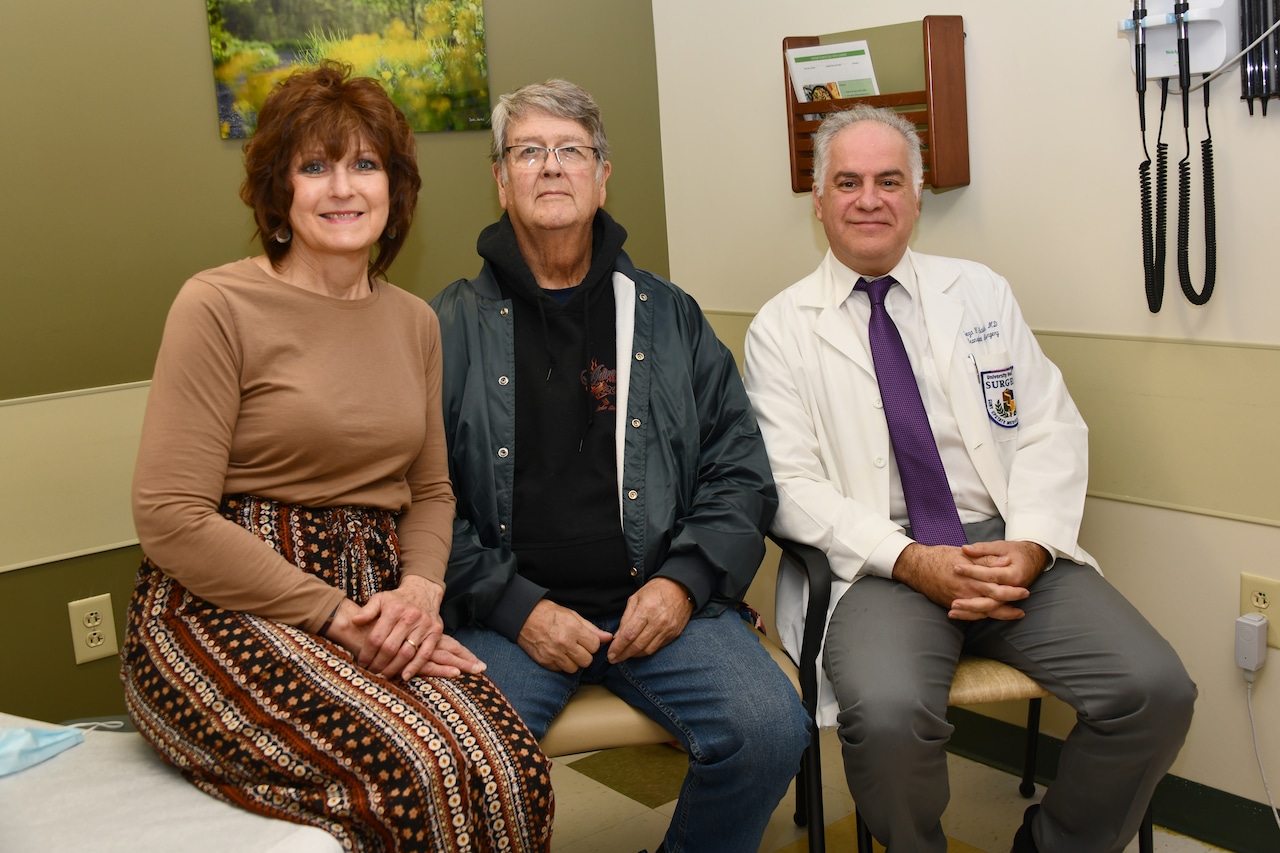
When Mark DeVito received his new kidney at SUNY Upstate Medical University in September, the moment marked far more than the end of a long wait. His transplant was the 500th living donor kidney transplant completed at Upstate, a milestone achieved through decades of work by one of the country’s oldest transplant programs.
The milestone also completed a circle of generosity that began two years earlier, when his wife, Anita, donated one of her kidneys, not to Mark, but to a stranger.
“If any story is about giving during the holiday season, one about kidney transplants seems fitting,” said Anita.
The DeVitos are part of the National Kidney Registry’s Paired Kidney Exchange, a program that allows someone who isn’t a match for their loved one to donate to another recipient, while a compatible kidney is secured for their own family member in return. When Anita learned she and her husband had different blood types, she knew donating directly to him wasn’t possible. But she didn’t hesitate once she learned another path existed.
“We learned about it when he started dialysis,” said Anita DeVito, a former dialysis nurse in Watertown.
A representative came to their house to explain his options.
“I knew donors could give to loved ones if they matched, but I did not realize there was a swap program,” Anita said.
Anita donated her kidney on Aug. 31, 2023. She said she had “absolutely no hesitation.”
“I wasn’t stressed at all,” she said. “I just knew I was helping somebody.”
Upstate began participating in the national paired exchange program in 2022. Mark had just begun peritoneal dialysis after his kidneys failed due to polycystic kidney disease, a hereditary condition that has affected multiple generations of his family.
For the DeVitos, the hardest part came after Anita donated her kidney. They waited more than two years for Mark’s turn.
He had two false starts along the way. In June 2024, he was just three days out from surgery when his blood pressure dropped too low, and the transplant was canceled. Months earlier, in December 2023, a kidney became available but was deemed unusable once harvested.
“I’ll be honest with you, I thought right to the last minute it could get canceled,” Mark said. “I was real hesitant that it was going to go through.”
Waiting meant staying close to home, never letting the phone out of reach.
“You don’t know when a kidney comes available,” he said. “You always make sure you have a phone with you… With a live donor, that was really nice because they tell you when they have it and set it up. You have time to plan.”
On Sept. 9, a kidney from a living donor in Boston finally arrived.
Mark’s surgery was lengthy and complex, involving major incisions and a long recovery. Since September, he has isolated to protect his newly transplanted kidney.
“About the only place I go is Upstate Hospital,” he said. “We usually hold Thanksgiving and Christmas dinner for the family but this year they don’t want me around large crowds.”
Even with the quieter season, gratitude is at the center of their holidays.
“It was a live donor, so they gave up a kidney to a total stranger,” Mark said. “I’m extremely thankful for that person.”
The couple also said the care they received at Upstate made the hardest moments easier.
“They’ve been fabulous, absolutely fabulous,” Mark said. “Everybody treated me wonderfully… I’ve never been treated so well in my life.”
Though Anita and Mark say they’ve always been close, this journey deepened that. Mark remembers asking her, right up until the day of her donation, if she was sure. She never wavered.
The couple is hopeful for the months ahead and grateful for what the past few months brought them. Their advice for other families considering the paired exchange program is simple.
“It’s wonderful,” Mark said. “I don’t think people realize it’s available or that you can live a normal life with one kidney.”
The DeVitos plan to celebrate Mark’s recovery with a cruise once he’s medically cleared.
“When he’s able to get out and enjoy his life, it will mean the world to me,” Anita said. “The thanks goes to his donor, not me.”

