
Table of Contents
Patient and biopsy characteristics
The patient characteristics are reported in Table 1. After patients without posttransplantation biopsies (N = 77) or biopsies of inadequate quality (N = 119) were excluded, a total of 6272 posttransplantation biopsies from 1814 patients were included in the derivation cohort. Validation was performed on two external cohorts: the European validation cohort consisted of 11,043 biopsies from 5898 transplants, and the US validation cohort consisted of 2185 biopsies from 1161 transplants.
Individual Banff lesion scores were assessed by local pathologists at each participating center. The final diagnosis, based on the integration of these scores and the human leukocyte antigen (HLA)-donor-specific antibody (DSA) status, was assigned by two expert reviewers (K.W. and M.N.) using the Banff 2022 classification criteria3 into the following, potentially coexisting, diagnostic categories: AMR (containing active, chronic active, and chronic AMR); probable AMR (hereafter referred to as “Probable AMR”); DSA-negative, C4d-negative microvascular inflammation (hereafter referred to as “MVIDSA-/C4d-“); borderline/suspicious for TCMR (hereafter referred to as “Borderline TCMR”); acute TCMR; and polyomavirus-associated nephropathy (hereafter referred to as PVAN); and normal or other changes as defined by Banff category 6 (hereafter referred to as “No rejection”). Following the reappraisal in recent studies of the role of the v-lesion in TCMR, biopsies with v > 0, t0-3i0 or t0i0-3, not meeting Banff AMR-MVI criteria, were considered as isolated v, and not as TCMR13,14. In this study, “mixed rejection” strictly refers to the concomitant presence of AMR and TCMR; “(Borderline) TCMR” refers to Borderline TCMR or TCMR.
Most transplants in the derivation cohort were from deceased donors (92.1%). In total, 273 (15.0%) recipients underwent retransplantations, and 151 (8.3%) recipients had pretransplantation HLA-DSAs. Among all the biopsies, 1,666 (26.6%) were performed for clinical indications, whereas the other 4,561 (72.7%) biopsies were performed per protocol. TCMR (7.2%) and Borderline TCMR (6.9%) were the most common rejection phenotypes. AMR occurred in 5.5%, MVIDSA-/C4d- in 4.4%, Probable AMR in 1.6%, isolated v in 2.4% and mixed rejection in 1.5% of the cases. A total of 4610 (73.5%) biopsies did not meet the criteria for the diagnostic categories and were classified as No rejection biopsies. The details of the diagnostic categories in the validation cohorts are reported in Table 1.
During the period of observation, 255 (14.1%) kidney allografts failed in the derivation cohort. In the European and US validation cohorts, 1009 (17.1%) and 171 (14.7%) kidney allografts failed, respectively.
Distribution of the continuous indices in relation to the Banff diagnostic (sub)categories
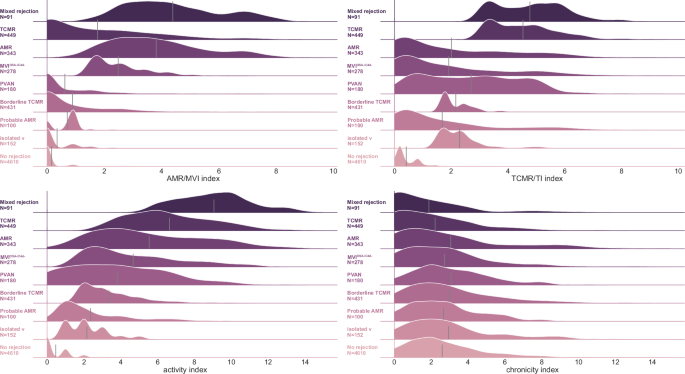
Given that AMR and TCMR constitute continuous disease spectra, AMR and TCMR can be represented by latent continuous variables instead of being regarded as strictly binary phenomena (present vs. absent). As such, we developed two indices based on a latent variable approach, where the unobserved latent component is inferred from a set of relevant, observed Banff lesions, with the binary diagnostic categories (AMR vs. no AMR, and TCMR vs. no TCMR) serving as the dependent variable to guide the inference of the latent variable (Online Methods). The activity and chronicity indices were adapted from previously published models10,11. The continuous indices included in the analyses, shown in Table 2, were calculated for all biopsies. The distribution of these indices in the derivation cohort is shown in Fig. 1.
Antibody-mediated rejection/microvascular inflammation (AMR/MVI) and T-cell-mediated rejection/tubulointerstitial inflammation (TCMR/TI), activity and chronicity indices, ordered by the mean activity index per category (gray vertical line). Both the AMR/MVI and TCMR/TI indices demonstrated logical and hierarchical ordering between No rejection, intermediate (Probable AMR, Borderline TCMR, isolated v) and complete rejection histology, with, in some cases, significant overlap. The activity index demonstrated similar gradual and hierarchical ordering between No rejection biopsies and fully inflamed categories, with intermediate categories (Borderline TCMR, Probable AMR and isolated v) in between. The chronicity index demonstrated low variability among the main diagnostic categories.
The index trained on AMR vs. no AMR gradually increased from No rejection to Probable AMR to AMR. As MVIDSA-/C4d- cases also presented high indices, we referred to this as the AMR/MVI index. The index trained on TCMR vs. no TCMR demonstrated a gradual increase from No rejection to Borderline TCMR to TCMR. In PVAN cases, this index was more broadly distributed and was significantly higher than in No rejection cases (Student t-test: p < 0.001), because the tubulointerstitial inflammation (TI) in a subset of PVAN biopsies was similar to those in TCMR biopsies. This second index was designated as the TCMR/TI index.
The Banff diagnostic categories were logically distributed in a two-dimensional space on the basis of a combination of the AMR/MVI index and the TCMR/TI index (Fig. 2). The AMR and MVIDSA-/C4d- cases demonstrated significant overlap of AMR/MVI indices. The highest AMR/MVI indices were observed for AMR cases, but this is inherent to the definition of MVIDSA-/C4d-, for which C4d negativity is required. TCMR and Borderline TCMR cases fell within well-defined boundaries set by the TCMR/TI index. Overall, the four indices were systematically greater in indication biopsies than in protocol biopsies (Supplementary Fig. 1), albeit with significant overlap across the range, demonstrating that severe inflammation and chronic injury can occur subclinically, with stable graft function.

Distribution of the individual biopsies per diagnostic category (in red) on the basis of the antibody-mediated rejection/microvascular inflammation (AMR/MVI) (y axis) and T-cell-mediated rejection/tubulointerstitial inflammation (TCMR/TI) indices (x axis). For visualization purposes, only the ‘pure’ phenotypes with no other concomitant diagnoses are displayed. No rejection biopsies are strictly characterized by both low AMR/MVI and low TCMR/TI indices, whereas Mixed rejection cases have both high AMR/MVI and TCMR/TI indices. High heterogeneity in Mixed rejection cases is, however, observed, resulting from the combination of various levels of intensity of the AMR and TCMR phenotypes within this diagnostic category. TCMR and Borderline TCMR cases are contained within clear boundaries of the TCMR/TI index. Probable AMR cases are restricted by a low AMR/MVI index. We note a significant overlap of the MVIDSA-/C4d- cases with the AMR cases in terms of the AMR/MVI index, although high values of the AMR/MVI index are affected only by biopsies.
The activity index exhibited a gradual and hierarchical increase from No rejection to fully inflamed categories (AMR, MVIDSA-/C4d-, TCMR and Mixed rejection), with intermediate categories (Borderline TCMR, Probable AMR and isolated v) in between (Fig. 1). The chronicity index demonstrated low variability among the main diagnostic categories (Fig. 1). Despite significantly different mean values of activity and chronicity indices among the acute/active, chronic-active, and chronic subcategories of AMR and TCMR, substantial overlap was observed in these indices across the subcategories (Supplementary Fig. 2). The latter analysis of the subcategories of TCMR was performed on a subset of the derivation cohort (N = 1635), for which scoring of critical lesions of chronic active TCMR, namely, ti and i-IFTA, was available. On another subset of 1254 biopsies with available lesion scores, the “i-IFTA” and “t-IFTA” scores correlated more strongly with the chronicity index (Spearman correlation: 0.40, p < 0.001 and 0.43, p < 0.001, respectively) than with the activity index (Spearman correlation: 0.10, p < 0.001 and 0.26, p < 0.001) and were therefore not considered for inclusion in the activity index.
The distributions of the four continuous indices across the main diagnostic categories were similar in the validation cohort and the derivation cohort (Supplementary Figs. 3 and 4), although the chronicity index was noticeably greater in both validation cohorts, with a greater spread and gradual increase from no rejection to mixed rejection categories. In the US cohort, TCMR/TI and activity indices were higher in cases of probable AMR, MVI, and AMR compared to the other cohorts. Higher activity indices were also observed in PVAN cases. The correlation between the activity indices and the chronicity indices was also more pronounced in both the European and the US validation cohorts (correlation coefficient [r]=0.18, P < 0.001 and r = 0.42, P < 0.001, respectively) than in the derivation cohort (r = −0.08, P < 0.001).
Discriminative performance of the AMR/MVI and TCMR/TI indices for Banff diagnostic categories
To demonstrate that the AMR/MVI and TCMR/TI indices maintain congruence with the clinically used Banff classification system of AMR and TCMR, we next evaluated the discriminative performance of the AMR/MVI and TCMR/TI indices for the Banff diagnostic categories, analyzing the derivation and validation cohorts separately.
In the derivation cohort (Table 3), the AMR/MVI index discriminated the presence of AMR from the absence of AMR, with an area under the receiver operating characteristic curve (AUC) of 0.98 (95% confidence interval [CI], 0.97 to 0.98). When MVIDSA-/C4d- cases were combined with AMR cases, the AUC was 0.98 (95% CI, 0.98 to 0.99). The TCMR/TI index demonstrated an AUC of 0.99 (95% CI, 0.99 to 0.99) for discriminating between the presence and absence of TCMR. This variable performed equally well if Borderline TCMR cases were considered TCMR cases (AUC 0.98; 95% CI, 0.97 to 0.98). Compared with the other diagnostic categories, the TCMR/TI index underperformed for the discrimination of PVAN, with an AUC of 0.83 (95% CI, 0.80–0.86), which can be explained by the absence of specific polyomavirus markers (e.g., SV40 staining results) in the TCMR/TI index formulation. The activity index discriminated No rejection from all other categories, with an AUC of 0.96 (95% CI, 0.95–0.96), and Mixed rejection from No Mixed rejection, with an AUC of 0.98 (95% CI, 0.98–0.99), clearly outperforming both the AMR/MVI and TCMR/TI indices on those two tasks. Overall, the area under the precision-recall curve (AUPRC), which is less impacted by significant class imbalance, demonstrated similar ordering of the variable performances among the different Banff categories as the AUC results (Supplementary Tables 1, 2 and 3). Compared to individual Banff lesions, the continuous indices provided smoother and more discriminative ROC curves and consistently outperformed single lesions in distinguishing between key diagnostic categories (Fig. 3).

Panel A shows ROC curves for individual acute Banff lesions, panel B for chronic lesions, and panel C for the derived continuous indices. ROC curves from individual Banff lesions appear stepwise due to the ordinal scoring system (four discrete levels), which limits granularity. In contrast, continuous indices produce smoother and more discriminative curves. Across all diagnostic comparisons, the three acute indices—AMR/MVI, TCMR/TI, and the activity index—consistently outperformed individual lesion scores. As expected, the chronicity index did not discriminate among rejection phenotypes. The lesions selected for each index typically had the highest AUCs within their diagnostic category, supporting their biological and diagnostic relevance.
As shown in Table 3 and Supplementary Tables 1, 2 and 3, the performances of all indices were similar in both validation cohorts for all discrimination tasks.
Additionally, sensitivity analyses revealed similar discrimination performance of the three acute indices (activity, AMR/MVI and TCMR/TI indices) across biopsy status (protocol vs. indication), recipient sex, recipient ethnicity, or biopsy timing (early vs. late post-transplant) (Supplementary Tables 4 to 7). The net benefit of the AMR/MVI and TCMR/TI indices was demonstrated for the discrimination of AMR and TCMR (Supplementary Results and Supplementary Fig. 5). The classification performances of the AMR/MVI and TCMR/TI indices across their ranges are detailed in the Supplementary Results: AMR/MVI and TCMR/TI indices ≥3 had 99.2% and 96.8% specificity for AMR/MVIDSA-/C4d- and TCMR, respectively (Supplementary Tables 8, 9 and 10). All Probable AMR (N = 327) and Borderline TCMR (N = 1972) cases had AMR/MVI and TCMR/TI indices, respectively, that were strictly inferior to 3 and strictly superior to 0 for Borderline TCMR cases (Supplementary Tables 11 and 12). For illustrative purposes, though we do not recommend discretizing the continuous indices, the AMR/MVI and TCMR/TI indices were divided into four categories using simple cut-off values (1, 3, and 6) (Supplementary Table 13). Most AMR and TCMR diagnoses fell into the high or severe categories, while the vast majority of “No Rejection” cases were classified in the low category. The few cases of No rejection with high indices were explained by peculiar lesion combinations (e.g. cg3, ptc0, g0, C4d0). Notably, intermediate phenotypes such as Borderline rejection and MVIDSA-/C4d- predominantly clustered in the medium index range, highlighting the ability of the indices to reflect a biologically meaningful continuum.
Associations of the indices with graft failure
To assess the relationships between different disease stages and outcomes, we analyzed the association of the four indices with long-term graft failure (Fig. 4; Supplementary Tables 14-15).

Associations with graft failure are shown for the activity (A), chronicity (B), AMR/MVI (C) and TCMR/TI (D) indices. Dots represent hazard ratios (HR) as the measure of centre, and error bars indicate the 95% confidence intervals (CIs). HR are adjusted for time posttransplantation, donor age, recipient age and recipient sex in the three cohorts. HR refers to a one-unit increase in the indices. The corresponding numbers, as well as the subsets sample sizes are reported in Table S14-S15.
In the derivation cohort, the four indices were associated with graft failure in Cox models adjusted for time posttransplantation, donor age, recipient age and recipient sex, with adjusted hazard ratios (HRs) of 1.30 (95% CI, 1.25–1.36) for the activity index, 1.29 (95% CI, 1.23–1.36) for the chronicity index, 1.49 (95% CI, 1.39–1.60) for the AMR/MVI index and 1.50 (95% CI, 1.39–1.61) for the TCMR/TI index, (based on the last biopsy per patient). Similar associations were observed in the two validation cohorts. In all three cohorts, the associations of the indices with graft failure were independent of the biopsy selected per patient. Notably, in a subset of the derivation cohort with available data (N = 3724), replacing the “i” score in the activity with “ti” in the activity index did not alter the results (Supplementary Fig. 6). In the overall cohort, the AMR/MVI and TCMR/TI indices yielded strata of increasing severity, as indicated by the significant associations of the AMR/MVI and TCMR/TI indices with graft failure (Fig. 5, Supplementary Fig. 7). Additionally, the indices effectively discriminated significantly different survival trends within the main Banff diagnostic categories. For example, AMR cases with a higher AMR/MVI index presented a greater risk of graft failure than did those with a lower AMR/MVI index. The same was true for MVIDSA-/C4d- cases stratified by the AMR/MVI index, as well as for (Borderline) TCMR cases stratified by the TCMR/TI index (Supplementary Fig. 8).

Kaplan-Meier curves of the AMR-related (A) and TCMR-related (C) Banff diagnostic categories and stratification of the AMR/MVI (B) and TCMR/TI (D) indices in three strata based on arbitrary cut-offs (all cohorts, N = 19,500). No AMR refers to all biopsies that are not AMR, Probable AMR or MVIDSA-/C4d-. Similarly, No TCMR refers to all biopsies that are not TCMR, Borderline TCMR or isolated v. Note that beyond those non-overlapping categories, concomitant diagnoses are possible (e.g. AMR cases can co-exist with TCMR and Borderline). Due to the negative exponential aspect of the index distributions, the discretization into low, medium and high index, was based on the index value at the 75th and 95th percentiles, corresponding to the following pairs of thresholds: 0.9 and 4.6 and; 1.6 and 4.5, and for the ARM/MVI index and TCMR/TI index, respectively. All Kaplan-Meier curves use the last biopsy per individual. P-values refer to log-rank tests. Shaded areas in panels B and D represent the 95% confidence interval for the Kaplan–Meier survival estimates. E Association of the four indices with the hazard of graft failure. Shaded areas represent the 95% confidence intervals around the model fit. The activity, chronicity and TCMR/TI indices linearly associate with graft outcome (p-value from Wald test for non-linear effect with restricted cubic splines with 3 knots: 0.86, 0.83 and 0.45, respectively). The AMR/MVI index demonstrated slight departures from a strict linear association (p = 0.004). Models based on a random biopsy per patient, all cohorts (N = 19,500).
The activity, chronicity and TCMR/TI indices demonstrated linear relationships with graft failure rates (i.e., a proportional increase in event rate with increasing index values, Fig. 5E). The AMR/MVI index demonstrated slight departures from a strict linear association (p = 0.004), although its overall relationship with graft failure remained stable and clinically interpretable (Fig. 4E). For each unit increase in the activity and chronicity indices, the relative hazard for graft failure increased by 15.0% (95% CI, 13.6 to 17.0%), 20.6% (95% CI, 18.0 to 22.9%) and 33.0% (95% CI, 28.0 to 38.2), respectively (computed on the whole cohort on the basis of a random biopsy per patient). These numbers, as reflected by HR, are also similar across the different cohorts (Fig. 3, all biopsies; Supplementary Tables 14 and 15). Overall, each unit increase in the AMR/MVI index corresponds roughly to a 22.4% (95% CI, 19.8 to 25.0%) increase in the relative hazard for graft failure (under a linear association).
These indices also maintained an association with graft outcome within most of the main Banff-defined diagnostic categories (Fig. 3, Supplementary Tables 14-15). Only in the No rejection and in Mixed rejection cases, which are less heterogeneous in terms of histological lesion scores, did the acutes indices (activity, AMR/MVI and TCMR/TI indices) not stratify outcomes further. Overall, similar associations of the indices with graft outcome were observed in both validation cohorts, except in the US cohort where AMR and chronicity indices were not associated with outcome in AMR cases, and no indices were associated in PVAN cases. In contrast to the derivation cohort, the activity and TCMR/TI indices even stratified outcomes within Mixed rejection cases in both validation cohorts.
Globally, the four indices associated with graft outcome irrespective of recipient sex, recipient ethnicity, timing of biopsy or indication vs. protocol status (Supplementary Fig. 9, ‘all biopsies’). These associations were maintained within most of the Banff categories with a few exceptions. The chronicity index was not associated with graft failure in the subset of protocol biopsies classified as TCMR. While the indices demonstrated similar associations with outcomes in Black and White recipients, these associations appeared attenuated in Asian recipients for all four indices. Whether this reflects a true biological difference or is due to limited statistical power in this subgroup remains unclear and warrants further investigation in larger datasets. Finally, we observed slightly higher associations with graft failure in late, biopsies compared to early biopsy for all indices for all categories.
The indices remained associated with graft failure within the AMR active, chronic-active, and chronic subcategories (Supplementary Fig. 10, Supplementary Table 11). Similar analyses of the TCMR/TI index within TCMR subcategories could not be performed because of the low prevalence of chronic active TCMR in the derivation subset and the lack of key Banff lesion scores, specifically ti and i-IFTA in the validation cohorts.

