
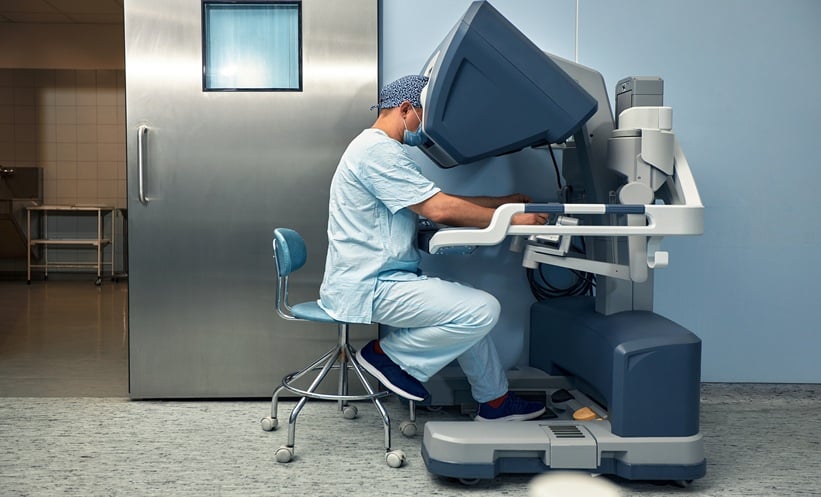
ROBOT-ASSISTED urinary reconstruction after kidney transplantation showed encouraging functional outcomes in a retrospective two-centre study of 24 kidney transplant recipients with ureteral complications.
Urinary complications occur in 4–10% of kidney transplant cases, with ureteral strictures and vesicoureteral reflux among the most common. Initial management frequently involves urinary diversion, while reconstructive surgery can provide definitive treatment when endoscopic approaches fail.
The study evaluated patients undergoing pyelo-native ureteral anastomosis, uretero-ureteral anastomosis or uretero-vesicostomy using robot-assisted laparoscopy between March 2018 and January 2026. The primary outcome was absence of an upper urinary diversion, including an endoureteral stent or nephrostomy, at one year.
What Were the Success Rates for Robot-Assisted Reconstruction?
Technical feasibility was achieved in 22 of 24 procedures, corresponding to 91.6%. Two procedures were terminated during surgery because complete pelvic retraction was present in the context of chronic graft rejection.
Overall treatment success, assessed using an intention-to-treat analysis, was 66.7% at one year, with 14 of 21 patients remaining free from urinary diversion. Among evaluable patients who underwent reconstruction, functional success reached 77.8%, with 14 of 18 patients achieving freedom from diversion.
Outcomes appeared most favourable following pyelo-native ureteral anastomosis. However, the small and heterogeneous subgroups prevented conclusions regarding superiority between reconstructive techniques.
No significant change in serum creatinine was observed. The small sample size also prevented conclusions regarding preservation of kidney graft function.
Which Patients May Benefit from Robot-Assisted Reconstruction?
Postoperative morbidity was considered acceptable despite the technical complexity of reconstruction. The findings suggest that robot-assisted laparoscopy could provide a minimally invasive alternative to open urinary reconstruction in selected kidney transplant recipients.
The approach may be particularly relevant for immunocompromised patients, where reducing surgical trauma and preserving peri-ureteral tissues could be advantageous. However, the study authors emphasised the need for specialised surgical expertise and careful patient selection.
The findings remain exploratory because of the retrospective design, two-centre setting and small effective sample size. Prospective multicentre studies are needed to confirm functional outcomes and establish the optimal indications for robot-assisted urinary reconstruction after kidney transplantation.
Reference
Boileau A et al. Robot-assisted pyelo-ureteral reconstruction for ureteral stricture in kidney transplant recipients: functional outcomes and perioperative morbidity from a bicentric cohort. World J Urol. 2026; 44:819.

