
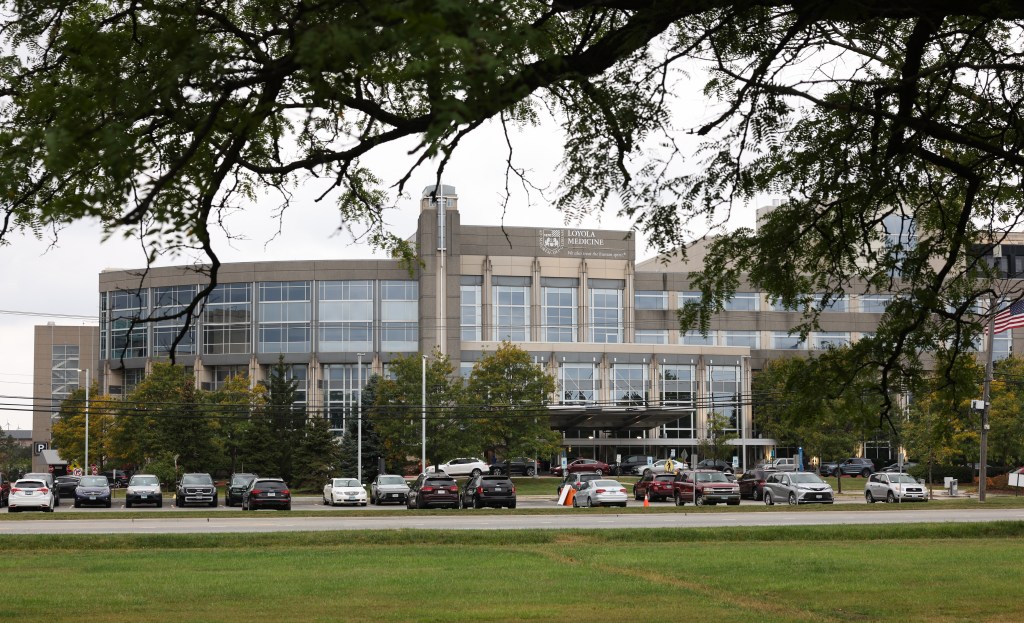
Loyola University Medical Center knowingly performed organ transplants on unsuitable patients to boost Medicare billing, leading to harm and death, according to a former hospital official whose recently unsealed federal lawsuit alleges a larger scheme “to extract federal and state funds from a system meant to support organ donation and save lives.”
Patrek Chase, former executive director for Loyola’s Solid Organ Transplant Programs and Outpatient Dialysis Clinic, alleges in the lawsuit that Loyola had area hospitals transfer “their sickest patients” for transplants.
“Loyola would then list these patients on the organ donor list as status 1A, meaning the patient was unlikely to live more than a few days without a transplant,” the lawsuit said. “This put the patient at the top of the donation list, and they were regularly able to match with the needed organ.”
But the Maywood hospital did not properly screen patients before carrying out the transplants, according to the lawsuit. Instead, the suit contends the hospital focused on billing and profitability, noting that Medicare would reimburse the hospital for discharging the patient “even if the reason for discharge was death.”
“Many of the patients died soon after Loyola provided these improper transplants,” the lawsuit alleges. Loyola “tolerated these deaths” and continued unsafe practices “to maximize Medicare billings,” according to the lawsuit.
The hospital also double billed Medicare for certain expenses and inflated costs on its cost report to Medicare, the lawsuit alleges.
A Loyola spokesperson declined to comment on the lawsuit, saying Loyola Medicine does not comment on pending litigation. In court documents, Loyola dismissed allegations that it “somehow acted improperly by allegedly choosing to treat especially sick patients” and defended its decision-making process.
The lawsuit, which also names two Texas hospitals as defendants, was first filed under seal in federal court in Texas in 2023. An amended complaint filed in August was made public after the federal government decided not to intervene in the case for now.
Chase was hired in October 2020 at Loyola, where he began raising concerns about “increased organ transplant failures, deaths, infections, and return to operation room (OR) rates,” the lawsuit states.
For instance, Chase alleges in the lawsuit that Loyola transplanted a liver into a patient with alcohol-related illness and unresolved alcohol use problems. If such a patient were to relapse, it could damage the liver and potentially require another transplant, according to the lawsuit.
The suit contends that Chase discussed this patient’s care with the hospital’s inpatient chief medical officer, who allegedly responded that “to increase transplant volume we need to be willing to take risks.”
Ultimately, the suit states: “The patient did not get better and stayed in the hospital for 128 days. The patient was on Medicare, and all 128 days of the hospital stay were paid for by Medicare. If Loyola had not done the transplant, the patient would not have needed the 128-day hospital stay.”
Chase alleges Loyola continually dismissed his concerns for the sake of “increasing transplant volumes” and he was asked to resign in May 2022 “in retaliation for uncovering Loyola’s fraud,” according to the lawsuit.
His suit also alleges psychiatric and social work teams regularly raised “red flags” when helping to determine whether patients should receive donated organs “but were continually overruled” by the hospital’s surgeons.
The patients “regularly experienced adverse incidents, including multiple cases of graft failures and deaths,” the lawsuit alleges.
These decisions had consequences for other patients on the waitlist for donated organs “who could have received a life-saving organ transplant” if Loyola had not given the organs to these questionable patients, the suit contends.
Loyola’s response to the lawsuit, filed in federal court, disputed that the hospital committed fraud and challenged Chase’s contentions.
For instance, Loyola argued that Chase “fails to identify any authority” for the claim that the hospital provided the patient with alcohol use issues with a transplant the person wasn’t eligible for.
The response also notes that the medical officer’s “alleged awareness of the fact that being ‘willing to take risks’ would increase transplant volumes” doesn’t mean the hospital committed fraud. Nor does the fact that the hospital receives payment “even when patients did not survive,” the hospital said.
“There is nothing improper about a hospital understanding the financial ramifications of its decisions,” the hospital said.
Long-standing ethical debates surround who can receive transplants, who can donate organs and how, said Dr. Kelly Michelson, a professor of pediatrics and director of the Center for Bioethics and Medical Humanities at Northwestern University Feinberg School of Medicine, who is not involved in the lawsuit.
For example, there continues to be debate in the transplant community about how to identify people with alcohol use disorder who should be eligible for transplantation, Michelson said.
“I think organ transplantation has been one of those areas that is just completely riddled with ethical challenges from every angle,” Michelson said. “Whenever you have a scarce resource, there’s going to be ethical challenges when it comes to how you allocate those scarce resources.”
Though hospitals rely on facts and clinical information to drive decisions about who should be prioritized for transplants, hospitals also may consider other factors, such as whether a patient will be able to stick to a prescribed treatment plan after receiving a transplant, Michelson said. Hospitals may differ in how they handle those types of issues.
Also, it may be easy to say a patient was too sick for a transplant or other type of surgery after the fact, when the outcome is clear, said Dr. Peter Angelos, director of the MacLean Center for Clinical Medical Ethics at the University of Chicago and chief of endocrine surgery for UChicago Medicine, who said he was not familiar with the lawsuit. But it may be difficult to prove that doctors knew in advance that a transplant wouldn’t benefit a patient, he said.

In addition to Loyola and the two Texas hospitals, the lawsuit names as a defendant the United Network for Organ Sharing, UNOS, a nonprofit organization that contracts with the federal government to manage the nation’s organ donation and transplant system.
The lawsuit alleges: “Instead of safeguarding the system, UNOS ignored clear instances of wrongdoing and patient harm despite its obligations, double-charged transplant centers in order to maximize its revenue, and failed to comply with federal cybersecurity regulations concerning patient and donor privacy.”
A spokesperson for UNOS said UNOS does not comment on pending litigation. In court documents it said: “The allegations regarding fees, oversight, and cybersecurity are conclusory, lack specific factual support, and at most describe regulatory or contractual disputes — not actionable fraud.”
The organization has come under fire in recent years, with a Senate committee investigation finding that UNOS wasn’t adequately overseeing organ procurement organizations across the country, leading to fewer organs available for transplant. Following that investigation, in 2023, President Joe Biden signed a bill into law to break up the contract to run the nation’s organ procurement and donation system, so multiple organizations, rather than just UNOS, could be in charge of different parts of the system.
Chase’s lawsuit also targets three organizations outside of Illinois that help procure organs.
The federal government said in a court document filed in June that it was not able to decide whether to join the lawsuit by the court’s deadline because the government’s “investigation has not been completed,” and the government noted that it planned to continue its investigation into the matter.

