Table of Contents
Public trust in organ donation in Egypt is shaped by concerns over illegal organ trafficking and diverse Islamic interpretations of posthumous donation. While some scholars support donation during life, others oppose it after death due to theological debates about the soul’s departure. These challenges highlight the need for transparent policies and culturally sensitive awareness efforts to promote legitimate organ donation practices12,29.
Willingness to donate: patients vs. Healthy individuals
“Willingness to donate posthumously was notably higher among patients than healthy individuals, and this willingness among patients appeared largely independent of socio-demographic factors; except for a reduced likelihood in those aged 45–65 years. In contrast, healthy individuals’ willingness was influenced by age, employment status, and legal awareness. Younger and employed participants were significantly more willing to donate, while higher socioeconomic status was associated with reduced willingness. Patients were also more open to surrogate consent, presumed consent, and incentivized models. Finally, legal awareness significantly increased donation willingness among healthy participants (p < 0.001) but had no effect on patients.
Our results suggest that chronic illness fosters an intrinsically stable willingness to donate, while healthy individuals’ attitudes are more shaped by external socio-demographic factors and legal awareness30. These findings reinforce the importance of structured legal education campaigns2,31,32.
The integration of TPB and HBM provides a useful lens for interpreting these group differences. TPB emphasizes the influence of subjective norms, perceived behavioral control, and attitudes toward behaviour; elements clearly reflected in healthy participants’ preferences for written consent, legal awareness, and autonomy18,33. HBM, on the other hand, highlights the role of perceived severity, susceptibility, and cues to action. All of which are especially relevant for patients whose illness heightens perceived need and benefits associated with donation19. The data from Table 3 supports this theoretical distinction: among healthy individuals, willingness was significantly influenced by employment (AOR = 5.99), legal awareness (AOR up to 4.57), and SES (AOR for Class A = 0.23), indicating the role of external control and social expectations (TPB). These associations highlight the predictive value of legal and social cues for individuals without chronic illness. The stronger effect of legal awareness among healthy participants highlights the importance of cues to action, supporting prior research showing that awareness of organ donation legislation strongly predicts willingness to donate in Egypt9.
Conversely, among patients, donation willingness was minimally influenced by external socio-demographic variables, reinforcing the HBM premise that perceived health vulnerability and intrinsic benefit perception override external factors.
Additional support for this divergence is seen in preference patterns from Table 2. Healthy participants showed a higher preference for written consent and donor-only models, reflecting TPB’s constructs of control and subjective norms. Meanwhile, patients were more open to surrogate and presumed consent, suggesting a utilitarian and experience-driven view consistent with HBM.
The role of chronic illness in donation willingness (Patients vs. Healthy Individuals)
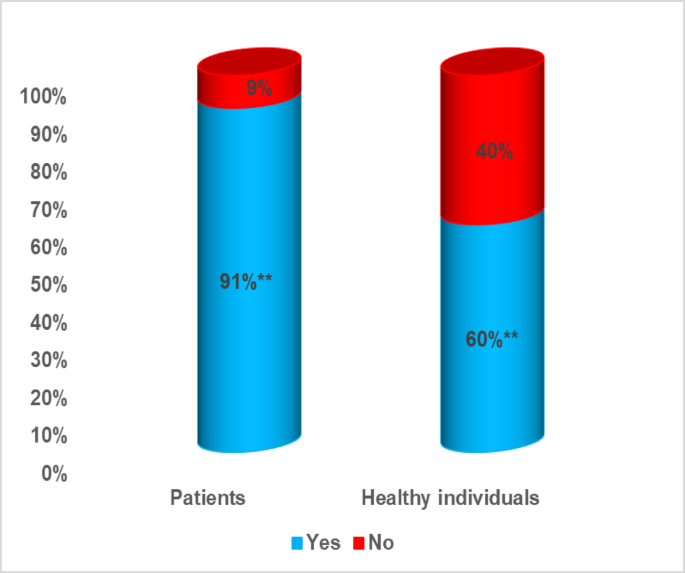
A notable finding was the significantly higher acceptance of posthumous donation among patients compared to healthy participants (91.0% vs. 60.0%, p < 0.01). This discrepancy may reflect patients’ personal encounters with chronic disease, which could enhance their empathy toward others awaiting transplants and deepen their appreciation of donation’s life-saving value. Additionally, the higher awareness of organ donation laws among patients (85% aware of at least one article) compared to healthy participants (78% aware) suggests that personal health challenges may drive individuals to seek more information about organ donation. This is consistent with international patterns, where individuals with personal or familial illness tend to report higher donation willingness29.
Our findings further demonstrate that donation willingness among patients is largely stable and internally driven, remaining unaffected by age, employment, or socioeconomic status (p > 0.05). This supports the notion that personal health experiences shape donation attitudes more strongly than external demographic variables. A study focusing on individuals with stage 5 chronic kidney disease (CKD) found that these patients generally held positive attitudes toward organ donation, and their willingness to donate was not significantly affected by socio-demographic variables. Similarly, our findings echo prior reports indicating that individuals with end-stage organ failure often maintain stable, favorable attitudes toward donation across diverse demographic groups9,29,34.
Influence of Socio-Demographic factors on willingness (Age, job Status, SES, legal Awareness)
The logistic regression analysis in this study identified several factors significantly affecting the willingness to donate among healthy participants, including age, education, occupation, and awareness of organ donation laws. In contrast, patients’ willingness to donate appeared largely unaffected by socio-demographic characteristics, suggesting that personal health experiences may play a more dominant role than external influences.
Among patients, older adults (> 65 years) were more likely to express willingness, whereas those aged 45–65 years were less inclined to donate. This pattern may reflect age-related variations in health concerns, risk perception, or trust in medical institutions. Although a study among university students reported better knowledge and positive attitudes in younger individuals35, age was not a statistically significant predictor among patients, suggesting a more uniform outlook across age groups36,37,38.
In healthy participants, younger age groups (< 25 and 25–45 years) showed significantly greater willingness to donate, consistent with international trends showing higher donation willingness in younger populations39.
Education level was not a strong predictor for either group, except for a borderline significant effect in patients with secondary education. This implies that general awareness and targeted messaging may be more effective than formal education alone. Although one Egyptian study found higher knowledge among medical students compared to non-medical peers35, international evidence from countries like Spain shows public campaigns to be more impactful than educational attainment alone39. Students among patients were significantly less willing to donate, possibly reflecting limited engagement with chronic illness care systems. Among healthy individuals, being employed or retired strongly predicted donation willingness, potentially due to greater financial and social stability. Similar patterns are observed globally; for instance, employed individuals in the U.S. are more likely to be registered donors39, pointing to broader socioeconomic determinants of donation attitudes37,38.
Interestingly, professional workers among patients were more likely to donate, while professionals among healthy participants were less likely. This may reflect greater empathy or healthcare exposure among chronically ill professionals, while healthy professionals could harbor more skepticism or concerns about medical risks. This dichotomy is observed in various countries, where healthcare professionals exhibit higher donation rates compared to other professions39.
For healthy participants, individuals in higher socioeconomic classes were significantly less likely to be willing to donate compared to the lowest class (D). This may suggest that wealthier individuals feel less urgency to donate or harbor greater distrust toward the healthcare system. In contrast, individuals from lower SES backgrounds may view organ donation as a meaningful social contribution or equalizer, a dynamic also reported in Brazil and other middle-income countries40.
Among healthy participants, awareness of organ donation laws was strongly associated with willingness to donate. Legal knowledge may reassure individuals about ethical safeguards and procedural transparency, thereby increasing trust in the system.
Sex was not a significant predictor in either group. This is in line with previous Egyptian findings35 and broader global literature indicating that gender has limited impact on organ donation attitudes39,41.
This consistency across diverse populations highlights the importance of societal and cultural factors in shaping attitudes toward organ donation, regardless of individual characteristics. Such findings emphasize the need for targeted public education campaigns that address these shared influences to enhance donation rates globally42. In Egypt, this may indicate that cultural and religious values exert a stronger influence than education alone in shaping donation attitudes.
Consent preferences and implications for policy (Written Consent, surrogate Involvement, Incentives)
The results suggest that patients with chronic illness may have a more flexible and pragmatic approach to consent options, potentially due to their own experiences with illness and medical systems. In contrast, healthy participants favored formal, written consent and were less accepting of surrogate or presumed consent models. Incentivized consent appeals to both groups, with a slightly stronger preference among patients.
The observed preference for written consent (75.2% among healthy participants and 70.1% among patients) mirrors global trends. Countries such as Spain and the United States, which have implemented structured consent protocols, tend to achieve higher donation rates. This preference among healthy individuals may reflect a desire for control and clarity in decision-making, reinforcing the perceived importance of autonomy in this group. Spain’s opt-out system exemplifies how structured legislative models can enhance donation rates43,44.
Incentivized consent was favored by both groups, with patients showing a significantly stronger preference (59.6% vs. 54.7%, p = 0.001). This may stem from the financial burdens associated with chronic illness, as incentives could offer practical relief and enhance motivation. These findings support global literature suggesting that financial or priority-based incentives can increase donation rates, although ethical concerns persist regarding the potential erosion of altruism32.
The preference for informed consent among healthy participants (12.2%) compared to patients (9.1%) supports the interpretation that healthy individuals prioritize autonomy, while patients anticipating possible incapacitation lean toward surrogate involvement. This distinction underscores how health status influences the perceived value of individual agency versus delegated decision-making36.
Surrogate consent was notably more acceptable to patients (10.1%) than healthy participants (5.8%), consistent with research showing that family involvement is critical in health crises. Patients may view surrogate consent as a practical necessity, given the unpredictability of medical emergencies. Studies from countries with opt-out systems demonstrate significant increases in donation rates over time, reinforcing the importance of adaptable models45.
Oral consent by the donor only is more acceptable to patients than healthy participants. This greater acceptance may reflect a preference for simplified consent processes, shaped by patients’ routine engagement with healthcare systems. For patients, consent processes that are less formal and more straightforward might seem more manageable, especially given the challenges they already face with their health46.
Finally, the preference for presumed consent among patients (8.3%) compared to healthy participants (4.5%) suggests a more utilitarian approach to organ donation, likely influenced by their medical experiences. This aligns with findings from Rithalia et al. (2009), which reported that presumed consent systems can increase donation rates by 25–30% in various countries. Additionally, a systematic review indicated that countries with presumed consent legislation see an increase of approximately 2.7 to 6.14 more donors per million population; These data emphasize the potential of presumed consent to improve organ availability, particularly when aligned with patient perspectives. This contrasts with healthy individuals, highlighting the policy potential of default-based consent models36,37,38.
Together, these findings highlight the need for nuanced, context-sensitive consent frameworks that account for health status, autonomy concerns, and economic realities. Policy efforts should consider the acceptability of different consent models among key subgroups and balance ethical imperatives with practical strategies to increase organ availability.
Awareness and actionable consent: international and local comparisons
In this study awareness of donation laws among patients had no significant effect on their willingness to donate suggesting that their motivation to donate was intrinsic rather than influenced by legal knowledge. This supports the notion that chronic illness fosters an internalized commitment to donation. The study findings align with and expand upon international research on organ donation. The 91% willingness rate among Egyptian patients is significantly higher than the Middle Eastern average of 49.8% reported by Mekkodathil et al. (2020)47. This suggests that chronic illness plays a significant role in shaping positive attitudes toward organ donation in Egypt, potentially surpassing regional norms.
In contrast, willingness rates in the U.S. are higher (77%)48, likely due to presumed consent legislation and robust public awareness efforts. Similarly, Saudi Arabia reports a 67% willingness rate49, suggesting that targeted public education efforts may contribute to increased acceptance. The elevated acceptance rate among patients in our study may reflect growing normalization of donation as a necessary and altruistic act, despite persistent cultural or systemic challenges.
Among healthy participants, however, greater awareness of organ donation laws was strongly associated with increased willingness to donate. This highlights the relevance of the Theory of Planned Behavior, particularly the roles of perceived behavioral control and cues to action. The strong association between legal awareness and donation willingness (p < 0.001) supports findings from other regions, which emphasize that transparency and clarity in legal frameworks foster public trust39,50.
On the other hand, a study published in BMC Medical Ethics assessed Egyptians’ preferences regarding consenting options for posthumous organ donation, as well as their awareness and acceptance levels. The study found that while a majority of respondents (95.1%) had heard of organ donation, only a minority had taken steps to document their consent2. Similarly, a second study identified a parallel gap between awareness and action: despite high awareness, few individuals had made formal arrangements or registered as donors51.
Despite high awareness levels, various factors such as religious beliefs, mistrust in the medical system, and fear of body mutilation contribute to the reluctance toward organ donation51. Understanding these culturally rooted barriers is essential for developing nuanced, sensitive campaigns that not only raise awareness but also facilitate action.

