
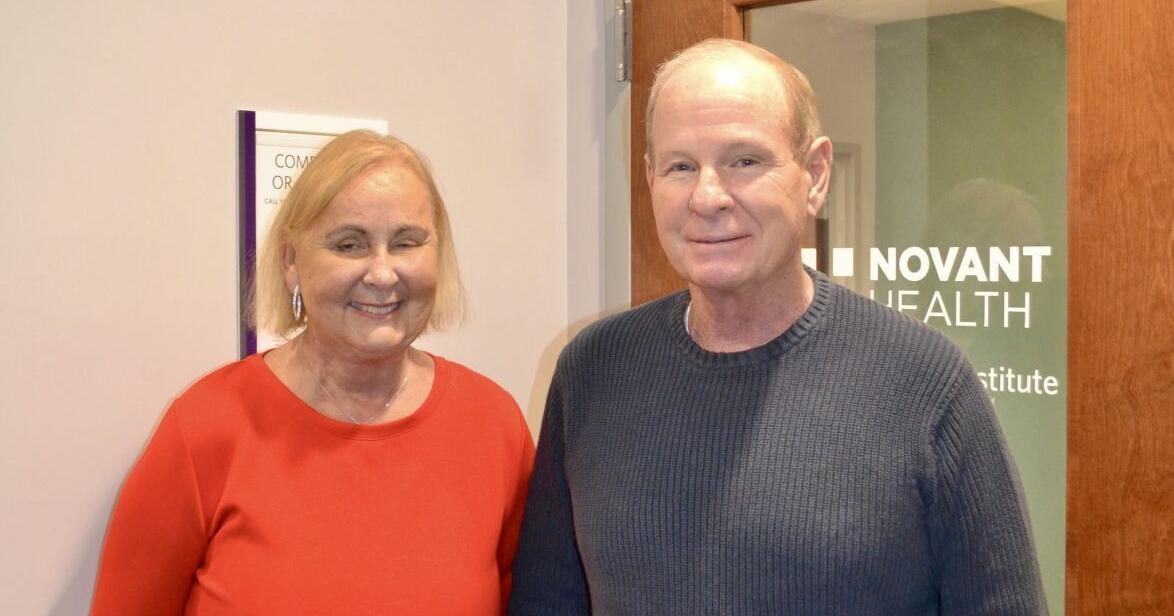
When Debbie Fenyak walked into a grocery store last summer, she didn’t expect a short trip for essentials to leave her gasping for air.
By the time she reached the checkout line, she could barely breathe. She had parked in a handicapped space but still struggled to make it across the lot. After 10 minutes inside the store, she asked an employee to help her back to her car to load up her items.
“It was like I couldn’t go up three steps in my garage to my kitchen without gasping for air,” Fenyak said. “That’s how bad it got.”
Within weeks, Fenyak would learn she needed a new heart.
Now, just three months after receiving a heart transplant at Duke University Hospital on Nov. 10, Fenyak is sharing her story in recognition of American Heart Month and Go Red for Women. The campaign is a national initiative focused on raising awareness about cardiovascular disease, the leading cause of death among women, Dr. Lisa Rose-Jones said.
Fenyak knew that she had a family history of heart disease. Her father died at age 42 after climbing a flight of stairs. All three of her brothers have vascular disease, and one underwent evaluations for a transplant earlier this month, she said.
Knowing her risk, Fenyak found a doctor after moving to St. James in Brunswick County. When she began experiencing shortness of breath in September, her doctor ordered testing. Shortly after she returned home, the phone rang, she said.
“He said, ‘I don’t want you to be alarmed, but I want you to go to the [emergency room] right away,’ ” Fenyak said. “So I got to the ER, they hooked me up to everything, and it turns out I had 16 pounds of extra fluid in my body.”
She received treatment and attended rehabilitation, but her symptoms persisted. Fenyak later required a pacemaker after further testing revealed dangerous instability in the rhythms of her heart, she said.
“I still just didn’t feel the best,” Fenyak said. “It was just shortness of breath.”
Fenyak was referred to Dr. Rose-Jones, a Novant Health advanced heart failure specialist. Further testing revealed that her heart’s ejection fraction, which is a measure of pumping strength, had dropped from normal levels. Rose-Jones gave her two options: a left ventricular assist device (LVAD) or a heart transplant, Fenyak said.
“I was in shock,” Fenyak said. “I mean, I had tears in my eyes.”
She then sought evaluations at Duke and was placed on the national transplant registry Oct. 25. Because she required continuous IV medication to support her failing heart, she was admitted to the hospital and classified as a higher-priority patient. Her A-positive blood type improved her chances of a match, as a universal recipient, Fenyak said.
On Halloween, she received her first call with news of a possible heart donor, but the heart was not a viable match. “It’s really deflating when you get all psyched up to have it,” Fenyak said. “My kids came to town, but that didn’t happen.”
On Nov. 9, another call came. This time, it was a match, she said. The next morning, she woke up with a new heart.
Only about 4,000 Americans receive heart transplants each year. While approximately 6 million Americans live with heart failure, transplants are a limited option. For women in particular, heart disease claims more lives than all cancers combined, Rose-Jones said.
“It’s a topic that is incredibly pertinent to our females here in the U.S.,” Rose-Jones said. “Over 60 million women in the U.S. are living with some form of cardiovascular disease. So we need to be more in tune to that, and get the word out of the importance of not only screening, but how we can prevent cardiovascular disease.”
Rose-Jones said heart disease in women often presents differently than many people expect.
“Many of us hear about the crushing, substernal chest pain, the elephant sitting on the chest,” Rose-Jones said. “That can be a sign of a heart attack. But for many of our female patients, that’s actually not the signs that they present with. It may be nausea, breathlessness … or extreme fatigue.”
Those atypical symptoms can lead women to dismiss warning signs or attribute them to stress, aging or busy schedules, she said.
“If symptoms come on acutely, meaning that you develop them out of nowhere,” Rose-Jones said, “whether it’s acute onset of shortness of breath or really severe nausea or indigestion or pain kind of in the chest cavity, someplace that may not be central, those are signs that you should seek immediate attention.”
She emphasized the importance of knowing key health numbers, including blood pressure and cholesterol levels, and taking steps to reduce risk through diet, exercise and regular checkups.
Fenyak’s recovery has been steady, but humbling, she said. She remains in isolation with her husband, Rich Fenyak, as her immune system is vulnerable. But soon after receiving her new heart, Fenyak was walking laps around the hospital and left Duke nine days after her transplant, she said.
“I anticipated getting back to normal things a whole lot faster,” Fenyak said, “and I just have to realize I have a new heart, and I need to give myself a break.”
Thinking back to her initial symptoms, she said she almost delayed care because her grandchildren were visiting.
“She knew she was in trouble,” Rich Fenyak said, “but she wouldn’t go to the hospital because the kids were in town.”
Now, she is urging other women not to ignore symptoms. Sharing her story during American Heart Month is about making sure other women recognize the signs before it is too late, she said.
“I would also like to encourage people to be organ donors,” Fenyak said, “because you never know. You never plan on something strange happening. It’s not your responsibility to give somebody else a life, but you can make such a difference.”

