Table of Contents
The day after my husband, Daniel, was told that he was dying and would need a heart transplant, I came into the bedroom to find him face down on the floor, unmoving. Despite my decades working as a nurse and years as a resuscitation expert, I stood, breath held, numb, as the enormity of the situation filled the air, the faces of our four children flashing around my head. Then he began to laugh like a drain, rolling around and clutching his stomach as he looked at me. “You absolute idiot,” I told him. Despite everything, the weight of his diagnoses of end-stage cardiomyopathy and end-stage heart failure (we kept being told “end stage”) at the age of 46, and the unknown that he was facing, he has always found humour; he’s always been kind. His heart, it turned out, was quite literally way too big.
Ours is a Nora Ephron kind of love story. Daniel and I met at nursery school, aged three and four respectively, and were thick as thieves — sitting together for carpet time, holding hands as we queued in line for milk and biscuits — but by the time we reached secondary school we seemingly had nothing in common at all. Teenage Daniel, with his curtain hairstyle and tic, was in the year younger than me, quiet and shy. I wore a permanent scowl after using an entire bottle of Sun In, developing Trump-coloured hair that turned more orange every day, and was only interested in older boys or smoking by the bins. We drifted apart into totally different lives.
• Read more expert advice on healthy living, fitness and wellbeing
After a 30-year hiatus, the universe threw us together again. During the pandemic we reconnected on social media, met up, hooked up, fell in love.
We were married in London in June 2023, and friends flew in to celebrate with us from across the world. Perhaps it was a later-in-life wedding that made people so happy and tearful, or a post-pandemic slice of joy, or maybe it was our families — our mothers would certainly have arranged this marriage themselves if it was our cultural norm. To find love is always beautiful, but to find love in my forties with someone I had known since I was a toddler, whose family I already knew and loved too, was surely a miracle. I was hopeful and excited for our future together. We were meant to be together, that was abundantly clear. In sickness and health. Until death do us part.
“You need to phone the kids.”
“It’s four in the morning.”
The couple’s marriage in 2023: “‘I had no idea that we were walking straight into a tornado”
COURTESY OF CHRISTIE WATSON
“Phone at five. Before they wheel you down, anyway.”
“What if they cancel again?”
“Then they cancel, but you need to phone the kids. At least a voice message.”
“Saying what?”
Silence. Then, “That you love them.”
A heart transplant is a treatment, not a cure
No fewer than three doctors came in during the night to tell us that Daniel had about a 15 per cent chance of dying on the table. “It’s a huge surgery and there is a risk you don’t wake up,” an anaesthetist said. “I know it’s not nice to think about, but it’s my job to make sure you’re aware.”
We were aware. The worst part — and there were many worst parts — were the what-ifs. In ours, they involved me telling our blended family, our four young adult children between us, that Daniel went to sleep and never woke up. Or the transplant didn’t come in time. Or he was one of the too many people who post-operatively developed complications and died, or didn’t make the first, rocky, dangerous year out. “This is not a straightforward cure,” a surgeon said. The female surgeons were straighter-talking than their male counterparts, I noticed, and the nurses the straightest of all. We knew by then that a heart transplant was a treatment, not a cure — a nurse had told us.

Christie and Daniel Watson on their honeymoon in America
COURTESY OF CHRISTIE WATSON
We were now members of the “transplant community”, a club that you never want to be part of, and found ourselves silently stalking community support groups on social media. In this space we learnt the truth of transplant: that there are very rarely people climbing mountains or running marathons after a heart transplant; those folk are the anomaly. A transplanted heart doesn’t last for ever; half of patients develop cardiac allograft vasculopathy within ten years (a narrowing and eventually blocking of blood vessels to the heart muscle). The immunosuppressant drugs required for life to avoid rejection of the new heart have nasty side-effects. They also make a person far more susceptible to serious infections and certain cancers — after an organ transplant, people are 100 times more likely to develop skin cancer than the rest of the population. Even then, the rejection of a new heart affects 30-40 of 100 patients within 12 months. Daniel would need regular biopsies up to 14 of them — during the first year if he stayed well.
Another little piece of my heart.
The thing that struck me about all the recipients we met either online in support groups or in physical waiting rooms was their strength and gratitude. It appeared that despite their daily struggles, people would do it again if given the choice. For Daniel, and for all people listed for a heart transplant, it wasn’t much of a decision in any case. Terrifying or not, without the transplant he would die.
• Young people ‘should be offered heart screenings to prevent tragedies’
“In some patients, a heart transplant improves survival, and we hope your quality of life will be better. It is a huge operation, and there are significant risks involved. But we think that in your case the benefits of the surgery outweigh the risks.”
We hope. We hope. We hope. I thought of what the neurosurgeon Paul Kalanithi wrote in his memoir, When Breath Becomes Air: “Doctors need hope too.”
“Whatever happens, the kids will all be OK,” I told Daniel. “I’ll make sure of it.”
“Nothing will happen,” he said.
But we updated our wills, and he wrote letters for our children that I hoped would remain unopened for ever.
I am in denial
It didn’t feel like it, but Daniel was extremely lucky to be on the heart transplant waiting list. He had been born with congenital hypertrophic cardiomyopathy — a thickening of the heart muscle — although he didn’t know it until his late thirties when he suddenly became very unwell. It was a complete shock. Aside from taking a few medications and having a “just in case” ICD — an implantable cardioverter defibrillator — fitted if his electrics ever went awry (cardiomyopathy is that sometimes silent condition discovered after a younger person suffers a sudden cardiac arrest on a sports field), Daniel lived as “normally” as the rest of us. During a routine annual appointment, I asked his medical team if a heart transplant was ever likely — in my nurse’s brain it was something on the horizon, a blurred mirage. A cardiologist reassured us Daniel was fit and well on the medications, which were so good these days. “A heart transplant discussion is way, way in the future,” he said. “If at all.”
Perhaps I was in denial. Perhaps the cardiologist was. Daniel was an expert at it.
“I feel like a frog in boiling water,” he finally admitted one day, after months of exhaustion and assurances he was “fine”. “Every day is incrementally worse,” he said, “and so slowly that I hardly notice. I’ve certainly felt better.”
He is dying, right there in front of us
2024. We had been married almost one year. Being married to me was surely no walk in the park but still, it shouldn’t have caused him such extreme fatigue, breathlessness, pain.
He changed colour overnight, from pink to pale to grey.
His heart thumped angrily, too slowly, abnormally. I’d avoid laying my head on his chest at night, and kept my fingers crossed he had a virus. I didn’t understand he was dying, right there in front of us. I suspect he did, though.
It was May, a month from our first-year anniversary, when Daniel called me from Harefield Hospital in northwest London. “Something is off,” he said. “There are a lot of people wanting to know if you’re coming in today too.”
• One-off injection ‘gives heart failure patients their life back’
By the time I arrived he was in a clinical room surrounded by surgeons. I sat down opposite them and listened as a consultant wearing neon orange trainers told Daniel he was end stage, and he needed a heart transplant imminently. Daniel said he was feeling OK, never fitter. “I can walk for miles,” he said. “Indefinitely.”
The doctors looked at me. And I looked at Daniel. And none of us called him out for lying. We’d all seen his insides. Them with their machines; me with my Nora Ephron knowing love.
“We have a window,” the consultant said. He didn’t say, “Before it’s too late,” but the words hung in the air anyway, along with the hospital smells of bleach and overcooked vegetables. “Any questions?”
“How long is the wait?”
“We can’t give an answer to that, I’m afraid,” he said. “Too many variables. But we will keep a very close eye on you now. Just in case.”
Neither of us asked what “in case” looked like, or how many people died waiting for a heart, but from googling I found out the average wait for a heart transplant was 18-24 months and the survival rate at five years post-transplant was 74.8 per cent. Later, a nurse told us that we hopefully wouldn’t be waiting long, because Daniel had no antibodies, was blood group A and was average height. Size mattered: the power outage of the donor heart had to match the recipient, so average was ideal. Daniel was also otherwise fit and well, didn’t drink more than two small beers a week, and had never taken so much as a puff of a cigarette.
There are no absolutes in the game of life and death; nursing had surely taught me that. Instead, a team of expert strangers weighed up the risks and benefits of a transplant, analysing Daniel’s pulmonary pressures, his antibodies, blood group and kidney, lung and systolic ventricular function, and ran right heart catheterisation tests — but they didn’t examine the most important parts of him. Daniel runs a food bank, I wanted to tell them. A baby bank. He gives out cots and nappies and food to people in need. He runs a charity, and he delivers toys at Christmas to families who can’t afford them. He can be really annoying and has questionable dress sense. But he is beloved by everyone who knows him. Cherished. Needed.
• Boy, 2, on life support after transplant heart ‘frozen by mistake’
We were told to think carefully about what type of heart donor Daniel would accept, how they died — suicide, drug overdose, brain cancer — or how they lived — smoker, history of drug use and hepatitis C. The team explained to us the difference between DCD (donation after circulatory death) and DBD (donation after brain stem death), and we sat a bit spooked trying to make sense of the idea that even death itself is contextual. Daniel was asked if he’d accept a donor older than 60. He was 46. The NHS blood and transfusion website reports that in the UK, about 300-400 people need a heart transplant but due to a lack of donors, only around 150-200 heart transplants are carried out every year. “They’ll only ever transplant a good heart,” a nurse said. “And a 65-year-old good heart will give you more time than yours will.”
We drove home from the hospital and the whole world looked different. Daniel glanced at me; I was unusually silent. “There’s no way I’m average height,” he said. “I’m taller than that.”
I smiled and then began to cry.
People’s stupid problems started pissing me off.
“I can’t shake this cold.”
“I need a holiday.”
“I am so fed up.”
“My back/head/arms/toes ache.”
Urgent emails, important birthdays, contracts, gas bills, dental checkups, our children’s young adult dramas, world politics… the seeming mundanity of all of it.
F*** off, I thought. F*** off.
‘There’s a heart. Would you like it?’
Within weeks, during May 2024, we had a phone call, with the Frankenstein-words, “There is a heart. Would you like to take it?”
Imagine that. A human heart. The clipped matter-of-fact voice of the specialist nurse for organ donation (SNOD) was at odds with the words themselves, the language that was at once grotesque, horrifying, against the natural order of things, and yet full of wonder and awe, wildly humbling. We stood together in the kitchen at 3am, without speaking but thinking the same. A person had died, a stranger, and in their darkest hours, in unimaginable, raw grief, their family had offered ours something they no longer had: hope.
• Artificial heart breakthrough that could make transplants obsolete
I’ll drive. The team had advised that I be the designated driver, as Daniel’s emotions would probably be all over the place.
“Are you sure?”
“I’m sure.”
I am a famously terrible driver. It was the first time I’d seen genuine concern on his face.
‘The heart’s not viable’
We spent the night at Harefield and Daniel was prepped for surgery: bloods taken, lines put in, Hibiwash-showered then chest shaved before the anaesthetist came to seek consent and go over risks, repeatedly. The transplant nurses popped in regularly with the breed of stoicism and just the right amount of cheerfulness that I knew in my nurse bones. Daniel slept a little at about 5am, and I watched the sunrise through the dirty windows. When he woke, Daniel phoned the children and told them he was about to have the heart transplant. “I love you,” he said.
The nurse came in mid-morning, shaking her head. “It’s not viable,” she said. “There’s evidence of arterial disease.”
And so we went home.
Christmas Day. We eat KFC from a bucket
October 2024, by then our third call, and we geared ourselves up for another false alarm, but it felt different. The SNOD was animated. “It’s definite. It’s happening. It’s a perfect match. We need to move quickly and get you into theatre.” As Daniel was about to be wheeled down, the nurse put her hand on his arm. “You feel a bit hot,” she said. She’d checked his temperature and rushed off. Another nurse came in and checked again. “It’s too dangerous. Any kind of infection and you are at much greater risk of dying on the table.” I watched her nurse’s poker face slip off momentarily into somewhere else, into a first-hand experience of this scenario, no doubt. She went to call it off.
• ‘You have our daughter’s heart’: how Keira’s death let Max live
Daniel was stunned. “Someone wanted to donate their heart, and because I’ve got a temperature and the heart is here already, now it’s too late for anyone else. That poor family.” He shook his head, eyes full of tears. “Someone isn’t getting that heart now. And the family who lost their loved one doesn’t get to give that gift. Because of me.”
We had no more calls in 2024. We spent Christmas Day that year ignoring the fact it was Christmas Day, phone on as usual in case. We ate KFC from a bucket, and I watched Daniel look greyer than ever, struggling to breathe.
We get the call. It feels surreal
January 2025, we got the call. Daniel danced into theatre with dozens of people clapping and cheering as he passed them in his theatre gown and pants, the scrub nurses, surgical team, reception staff. He waved at me, grinning, then disappeared through the heavy theatre doors. It all felt so surreal, cartoon-like, preposterous. I spent the next ten hours pacing around the local area, clinging to the sides of Harefield Hospital like fog.

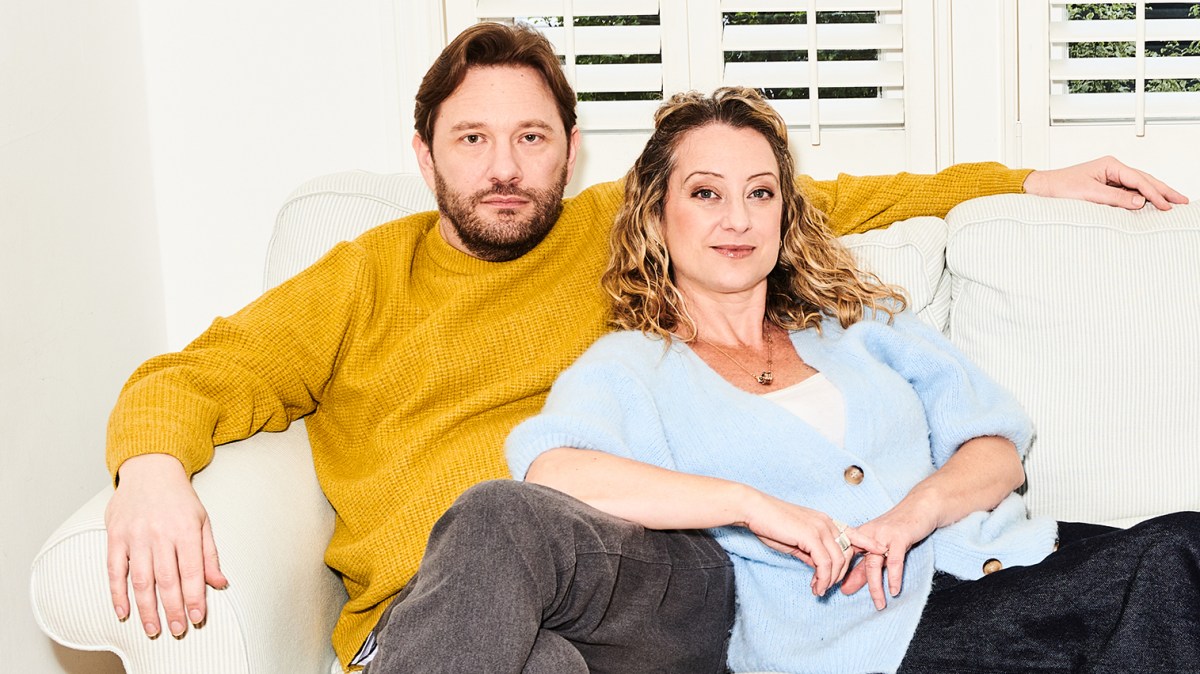
“I worked for years in paediatric intensive care. But still I watched the medics in total awe”
TOM JACKSON FOR THE TIMES MAGAZINE. HAIR AND MAKE-UP: NIKI MARK USING LISA ELDRIDGE AND CHARLOTTE TILBURY
They’d warned me it might be six or eight hours, but after that, time slowed down even more. I was almost hysterical when the phone rang ten hours after Daniel had gone under. “He’s alive.” The surgeon. “A few minor blips and a bit more bleeding than we’d hoped, so it took longer. He’s being transferred to the intensive care unit [ICU] and they’ll need some time to get him sorted, so get some rest.”
I ran to the ICU.
Daniel laughs until his alarms blare. Nurses run in
The ICU at Harefield Hospital is reflective of the wider NHS. It is too hot, housed in a building that looks like it needs gutting, and it’s stuffed full of the most highly skilled, compassionate, incredible staff you could imagine. The team of nurses and doctors and allied health professionals, all saving lives every single day in many more ways than simply resuscitating. Daniel was one of many patients on life support machines, covered in tubes and wires and hooked up to every piece of equipment. And yet they treated him — and me — like family. Having worked so many years in paediatric intensive care, I knew this holistic and compassionate care. Still, I watched them in total awe. Daniel was in safe hands. The intensive care was a place of intensity and tragedy, but it was filled with miracles thanks to the staff.
I sat by Daniel’s bedside, ignoring the flashing, screeching alarms, and wrote a section of my next novel, Killing Me Softly, a thriller as dark and twisty as the space we were in, but filled with humour like we had too. When Daniel was moved to high dependency and awake, he asked how I was coping. “By writing about potential murdery nurses,” I said. And he laughed until his alarms blared out and the real-life nurses — who, unlike some of my fictional characters, were compassionate as well as competent — ran in to help.
Life has never felt more precious
Daniel was home after a few weeks, but recovery was brutal. Like all things illness, it was the mental health aspects that were the most challenging; the number of steroids Daniel was taking to avoid rejection of the new heart would turn even the gentlest of people into the Incredible Hulk.
It was a poet friend, Zaffar Kunial, who made the most sense to me as Daniel slowly recovered. “It’s a heart. This is more than simply an operation. It’s not that he’s somebody else, but that he’s Daniel and someone else. Someone lives on in him. He carries their heart.” The enormity of that notion stretched around us and yet it gave us comfort. A heart transplant is much more than simply bodies. It is two lives, inextricably linked for ever, cell memories merging together and fusing into one. Daniel’s personality, once he’d been weaned off the heavy-duty steroids at least, was as it ever was. But on some deep, primal level, his soul had shifted and made room for a piece of another’s. This new body and life and way of seeing took a long time to settle. Now, one year after the transplant, he has daily challenges, pain is never too far away, but he is laughing like a drain again. Life has never felt more extraordinarily precious. What a gift.
At night these days I lay my head on Daniel’s chest and I listen to another beat, a different music. I imagine a person and a family whom we may never know but who have made this all possible, with life, then death, then life again. Daniel and I don’t know anything about this stranger — he was allowed to write to their family via the hospital, but they are under no pressure to receive the letter or write back — but we think of them often. We don’t know — or care — of their gender, age, condition, their work, where they lived, how they died. Instead, when we discuss, wonderstruck, this healthy heart inside Daniel, a metronome reminder that time is not guaranteed for any of us, the only important questions take laser focus:
Who did they love?
Who loved them back?
We’ll honour his donor with joy
Daniel lives, thanks to the love of a stranger and their family. We plan to honour them with joy, gratitude and hope, remembering that in this complex world, at this dangerous time, human kindness beats on. I had no idea on our wedding day that we were walking straight into a tornado, without time to build foundations, yet I’d do it all over again despite the trauma of our opening act.
As a medical professional, I thought I understood what heart transplant meant, and I didn’t — it is a far harder and more beautiful business than I could have imagined. I thought I understood what marriage meant, and I didn’t — it is a far harder and more beautiful business than I could have imagined. How we live our one precious life is often influenced by things out of our control: health, finances, luck. But whom we choose to spend our lives with can turn chicken shit into chicken salad. If we’re extremely lucky, despite the odds — and despite the cost — we might find a match for our fragile, human hearts.
To register to become an organ donor, visit organdonation.nhs.uk
Killing Me Softly by Christie Watson (Phoenix, £20) is out now. To order a copy go to timesbookshop.co.uk or call 020 3176 2935. Discount for Times+ members

