
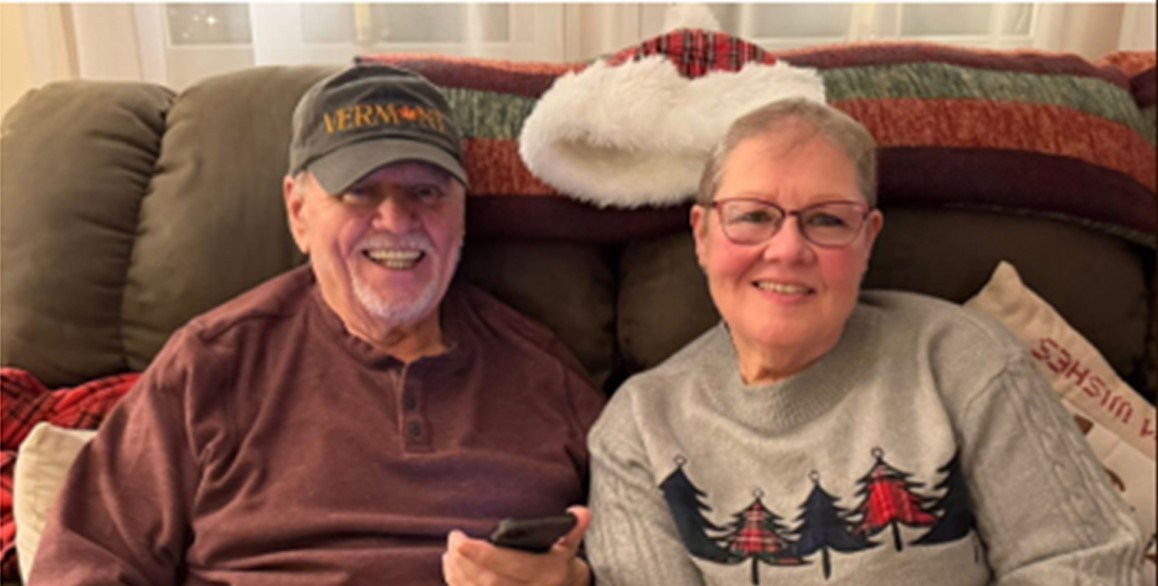
Lifelong Meriden resident Sandra Binkowski received a kidney transplant as a teenager. Now 50 years later, she is celebrating the anniversary of her procedure, and she is still going strong.
Health experts at Hartford HealthCare said Binkowski is one of the longest living kidney transplant recipients in Hartford Hospital‘s history.
Binkowski said recurring strep throat infections led to kidney failure and congestive heart failure when she was a teenager. Prior to her transplant, Binkowski said she had trouble breathing and was being treated for high blood pressure. Two weeks later, she felt worse and asked her mother to take her to the emergency room. It was then that she learned she needed a new kidney.
“I knew something was wrong. I couldn’t breathe. I was in heart failure and that’s how it started,” Binkowski said. “I was 18 when I got sick in February of 1976 and I went into congestive heart failure and I was hospitalized for a couple of weeks. I was told by my nephrologist, ‘One of these days, your kidneys are going to go’ and I would need dialysis.”
Binkowski was on dialysis for 3 1/2 months when she learned that her older brother, Joe Binkowski, was considered the “perfect match.” In fact, he was the first and only person tested as a living donor.
She received a living donor transplant from her brother on Nov. 9, 1976, at Hartford Hospital when she was 19 years old.
“Joe is about five years older than I am and, when he donated his kidney, he was in his 20’s was active and a softball player. He told me, “I see what you are going through, and I have to do it,’” Sandra Binkowski said.
Now 69 years old, Sandra Binkowski has flourished over the last 50 years. She became a registered nurse in 1985, and retired four years ago. Sandra Binkowski worked in the operating room at Midstate Medical Center for about 20 years, then worked at the eye surgery center at Hartford Hospital for 16 years.
Last month, Sandra Binkowski participated at the 2026 Connecticut Kidney Walk at Hubbard Park in Meriden and her team finished in first place and raised nearly $12,000.
“You would not believe the people who wanted to talk to me. They kept saying they couldn’t believe it and asking me what the secret is. There’s no secret. You have to make sure you always keep your appointments and take your medications,” said Sandra Binkowski, noting that any time her primary doctor prescribes her a new medicine, she calls the transplant office to get their approval. She currently sees Hartford HealthCare transplant doctor Dr. Joseph Singh once a year and has bloodwork once every four months.
Sandy Binkowski never married or had children but has two nieces and a nephew and four great nephews. She said they know her story. “They’re just happy to have me around,” she said.
Courtesy of Sandra Binkowski
A childhood photo of siblings Sandra Binkowski and Joe Binkowski. In 1976, Sandy Binkowski received a kidney transplant from her brother. (Courtesy of Sandra Binkowski)
Exceeding expectations
Singh, medical director of the kidney transplant program for Hartford HealthCare, has been Sandra Binkowski’s doctor for about eight years.
“I find her outlook on life remarkable. She is someone who faces her challenges and never gets overwhelmed,” Singh said. “She’s had other health issues not associated with her transplant but because of advancing age and she has amazing strength and is really an inspiration.”
Singh said he “channels Sandra, without specific information, for other patients who are struggling with complicated issues.”
“You provide examples of people who’ve gone through hard times and been able to push through and continue. I think that’s important for patients to have some personal or anecdotal experience to draw on,” Singh said.
Singh said he’s amazed by Sandra Binkowski every time he sees her. He said if she is not the longest surviving kidney transplant survivor in Hartford Hospital, she’s “close to the top.”
“The typical kidney transplant for the organ itself is 10 to 12 years. She’s five times past that expectation of survival and not only is it functioning, but it’s functioning well. She’s got great kidney function. It’s remarkable. It’s a gift. I think it’s really miraculous. I can’t imagine there are too many others like her,” Singh said.
Singh said some of the reasons for her longevity are because the organ was from a sibling and because she stays on top of her care and taking her medications.
“We’re pooling all this data together, and that includes not just people who’ve gotten kidneys from live donors, but also kidneys from deceased donors. We have been trying to improve access to transplants and have been pushing the boundaries of using different organs that in the past, we may have passed on due to concern that it wouldn’t work,” Singh said.
“We’ve been able to use some of these kidneys that we would have discarded and those kidneys work well. If you can meet them with the right recipient to provide life extension or a quality-of-life improvement needed for that particular patient. If you have an organ that won’t last 10 years but you have a recipient who may not have many years predicted ahead of them, you may give them the ability to get that transplant and have the opportunity to come off dialysis and have an improved quality of life,” Singh added.
Singh said surgery techniques have also improved greatly over the years, with a minimally invasive surgery using a laparoscope and a robot to do the surgery. He also noted that there isn’t as much scarring as there was in past decades.
“It allows doctors to do manipulations that your hand wouldn’t be able to do and even reduce injury to the donor,” Singh said. “Medications have also improved preventing rejection to avoid adverse effects. Older imminent suppression increased cardiovascular risk, bone loss, metabolic syndrome and the newer medications we have can avoid some of those things.”
“Sandra benefitted from a live donor and that process is really meaningful. It changed her whole life. She’s survived much longer than she would have if she was on dialysis. Dialysis outcomes are three-to-five year survival, and she is 10 times that. She enjoys a reasonable quality of life, with a relatively normal experience and that’s a wonderful thing. That is a gift that is so precious. Her brother is a wonderful person to have gone through that process and given her this chance,” Singh said.
Improving outcomes
Dr. Oscar Serrano has been a transplant surgeon at Hartford HealthCare since 2018 and is also the head of the medical advisory board for the National Kidney Foundation. He noted that the average person who receives a living kidney donor lives 15 to 20 years on average.
“That’s an average with it being a bell curve. Most patients have their kidney anywhere from 10 to 30 years,” Serrano said. “To go 50 years is significant.”
According to Serrano, the first-ever kidney transplant took place in Boston in 1954. The transplant program started at Hartford Hospital over 50 years ago and was one of the first hospitals to do so.
Serrano said finding kidney donors has evolved over the years. Initially, living donors came from a family member and close friends. He said now there are kidney swaps and the chains can span large portions of the country.
According to Serrano, the most important part of this story is what Sandra Binkowski has accomplished in life and everything she has been able to do because she’s not on dialysis.
“We know a transplant is going to prolong her life, improve the quality of her life in the way that most of us see it. It’s not just one person that we’re helping. We’re helping an entire community, entire families, generations that are going to contribute to our country and our society,” he said.
Serrano said patient outlook for those needing kidney transplants have improved remarkably over the decades.
“We have better immunosuppression drugs that, number one, help you not reject the kidney. But on the other hand, the side effects from them, in other words, infections and other things have improved. Our outcomes continue to improve as the years go by. We now have a lot more accessibility to living donations,” Serrano said.
“Sandra’s case living out 50 years is an extremely rare case,” he added. “Compared to 20 years ago, the outcomes for kidney transplantation are so much better. I don’t think Sandra’s going to be the first person we see in our program who’s living out to 50. I hope she will be one of many.”

