At the American Society of Nephrology Kidney Week 2025, late-breaking results from the phase 2 BESTOW trial offered updates in transplant immunosuppression. The study evaluated tegoprubart, an investigational anti-CD40L monoclonal antibody, in a head-to-head comparison with tacrolimus in de novo kidney transplant recipients. Although the primary end point of 12-month estimated glomerular filtration rate (eGFR) did not reach statistical significance, tegoprubart showed numerically higher kidney function in key subgroups and demonstrated striking reductions in metabolic, neurologic, and cardiovascular toxicities that have long challenged calcineurin inhibitor–based regimens. The findings have renewed interest in costimulatory blockade to improve long-term graft health while easing the treatment burden for patients.
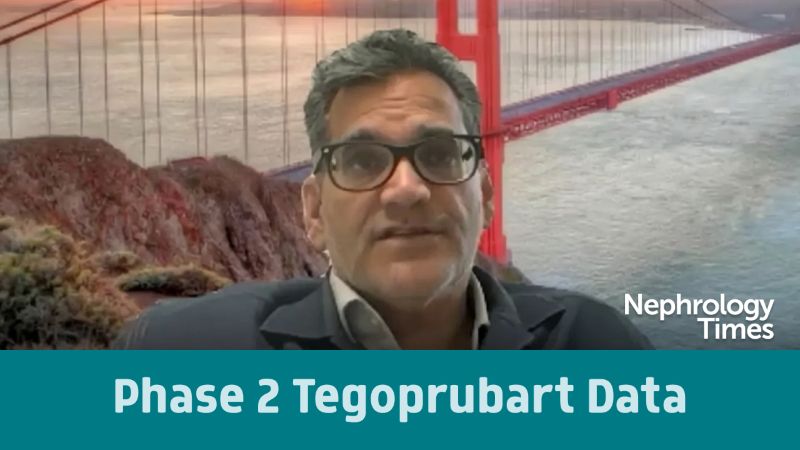
To help contextualize the results, we spoke with John Gill, MD, of the University of British Columbia, an investigator in the phase 1 trial. Dr. Gill discussed the limitations of tacrolimus-based therapy, how CD40L blockade may reshape immune modulation, and how he interprets the phase 2 data—including subgroup effects, safety signals, and what he believes phase 3 will need to show before tegoprubart can be considered a true alternative to tacrolimus.
What are the key challenges of tacrolimus-based immunosuppression?
One of our major challenges in kidney transplantation is long-term allograft survival. We really have excellent short-term outcomes, greater than 95% in deceased donors [transplant recipients’] 1-year survival and greater than 98% for living donors. But we haven’t really made an improvement in long-term allograft survival. Part of the reason for that is, number one, the current cornerstone for our immunosuppression, which is tacrolimus, is very good at preventing rejection in the first year. But in the long term, we believe that it is actually scarring to the allograft. So, we see a progressive attrition of GFR.
In addition to that, we know that patients tolerate it poorly, and so that can lead to issues with achieving therapeutic exposure to the drug, whether that be through nonadherence or poor exposure, because patients have side effects from the drugs. Then lastly, the other issue we don’t like with CNIs [calcineurin inhibitors] or tacrolimus-based therapy is there are significant side effects, which include things like diabetes, hypertension, dyslipidemia, and then just a general state of—let’s just say, almost like being hungover. Many of our patients will complain of being in a fog, not being mentally sharp, having neurological side effects, such as tremor. So, for a variety of reasons, the calcineurin inhibitors, which have allowed us to expand transplantation, are drugs that we would love to have a better long-term immunosuppressant for.
How does tegoprubart’s mechanism of action differentiate it or improve upon other immunosuppressants?
The way to think about it is, your T-cells, which are the cells that cause rejection, are key mediators of rejection. They need two “on switches,” and calcineurin inhibitors don’t really prevent activation of the T-cell at the sort of switch phase. They do it internally after the downstream effect of one of the main signals is turned on, called Signal 1. The way tegoprubart works is it actually blocks what’s called the second switch, or that costimulatory switch.
Not only does it prevent the T-cell from being activated, but by working on that pathway, we believe it suppresses both T-cell and B-cell activation, and that then also prevents priming of other immune cells, which normally kind of turn on when the T-cell is activated. These include natural killer cells and other cells that cause inflammation in the transplant. We believe that affecting that pathway instead of just shutting down the T-cell at the Signal 1 pathway, by working through Signal 2, it actually has a lot of beneficial, what we call, tolerogenic signals. Preventing B-cell activation, but also turning on healthy cells, which we think are tolerogenic and in the long term will be beneficial. These really include FOXP3 cells, which are regulatory cells that we like to be enriched in the transplant. We think that tego [tegoprubart] is much more friendly from that perspective, if that makes sense.
The 12-month change in eGFR wasn’t statistically significant, but kidney function was numerically higher. How should clinicians view this?
The tego group did exactly what we thought it was going to do. It gave us spectacular kidney function—really if you look at the numbers of GFR and overall GFR of 66 mL/min, I think [that] is what they showed, which is really what you would have expected from the phase 1 data.
What was surprising in this trial was the fact that the tacrolimus group did better than expected. That lack of separation between the tego and the tacrolimus groups was really surprising, and that it was driven in part, surprisingly, by the fact that the deceased-donor cohort that was recruited into the study was really a very low-risk cohort.
So, tacrolimus—we didn’t talk about it—but it is a vasoconstrictor. … That vasoconstrictor effect that we expect from tacrolimus and the secondary effects on GFR … might not have been seen in this low-risk deceased donor group. The way I would point to that is, if you look at the subgroup of the GFR in the living donors, for example, the tego results were really spectacular. They hit over 72 mL/min in the living donors. There, you saw the tacrolimus group actually do 62 overall in the living donor groups, which is kind of what I would expect.
But then, surprisingly, in the overall deceased-donor group, the tacrolimus group actually outperformed the living-donor group, which is really kind of a weird thing. So, the GFR in the tac [tacrolimus] group in the deceased donors was 68 versus only, I think, 62 in the living donors for tac, which is really surprising.
There [are] some—I would almost call them surprisingly good results in the deceased-donor group, in the tacrolimus group. But the tego group behaved as you would expect it to. It gave excellent kidney function. This is a bit of an anomaly. Surprisingly good results is what I took away from the presentation for the tacrolimus GFR.
Safety findings were striking (eg, lower rates of new-onset diabetes, tremor). Which safety signals are most meaningful for patients?
The first thing to look at is just the infections, and the infectious complication rates in both groups [were] as we would expect. So, it’s really a pick. I’m not really seeing any big safety signals in terms of infectious complications in the tego compared to the tacrolimus group, surprisingly. In fact, there was more bacteremia in the tacrolimus group. Not that I think that’s a real thing. I just want your readers and viewers to know that you do expect infectious complications.
Basically, they were very much as expected in both of those groups. So, little imbalances and infections here were not consequential, and you’ll see that in any trial where you saw some … really interesting differences were in the effects that we already highlighted. New onset diabetes [was] dramatically different in the tego group, having very little, and what you’d expect in tacrolimus. So, [there was a] significant difference there. Things like tremor were also significantly different and much higher in those two groups. All the other stuff that we touched on that you would expect—hypertension, et cetera—was all worse in the tacrolimus group.
I would say, from a safety profile overall on balance, these things significantly favored tegoprubart. The thing that I would highlight is what they didn’t really have here is patient-reported outcomes. Having been an investigator, not in this study, but in the phase 1 study of tegoprubart, I can tell you that the patients that take this drug generally have a really good sense of well-being. So, that was one thing that you would have liked to have seen. “Here [are] some patient-reported outcomes which would validate that impression.”
What questions need to be addressed in phase 3 before tegoprubart could be considered a viable alternative to tacrolimus?
First of all, this data is very promising for a phase 3 study. What you do want to see in a phase 3 study is the more real-world deceased-donor exposure. The types of kidneys that I’m transplanting every day are from people who are donors in their 60s among deceased donors. You’d like to see a more representative cohort for that.
The other really interesting finding here was an early difference in delayed graft function. We do think that calcineurin inhibitors do contribute to delayed graft function, and to see that difference in this phase 2 trial actually sort of be measurable, it was another interesting thing.
But the biggest thing is, when we interpret the GFR at 1 year, what we’ve learned from the previous exposure with costimulatory blockers, specifically belatacept, is that GFR that you achieve at 1 year is then a stable GFR going forward in the long term. Even in this phase 2 data, I want to see in the next couple of years the stability of the GFR, which I expected to remain very stable in the tego group. But to see that—what we expect is that it won’t be stable in the tacrolimus group. For whatever reason, in this trial we had a very high GFR in the tacrolimus group. I don’t expect that to be sustained. Longer-term outcomes, even in this trial, [are] what I would like to see—to validate that we do think that this pathway is favorable for long-term graft health and the stability of that GFR, is a key thing for this study.
For the phase 3 study, it still is [a] relatively small experience with 60-odd patients in each group. In a bigger study, you want to see the more real-world exposure, and probably what I would anticipate to see is the bigger differences in GFR. I was anticipating that these differences would be on order of about 10 mL between the two groups. It’s interesting that, in this study, you do see that difference in the living donors and in the higher-KDPI [Kidney Donor Profile Index] deceased donors. But really, some of the anomalous findings you see here [are] because we had really a low-risk deceased donor group which washed out some of the differences.
Do you have any final thoughts?
Overall, the reason we do trials is to learn more about these drugs. What is important here is that, even though there was a higher rejection rate in the tego group, the one thing we have to get our head around is that those rejections in the patients that stay on the drug, they do spectacularly well. Even though the rejections look like they’re significant from a Banff grade, their functional consequence at 1 year is not something that is a concern. These are exclusively, in our experience, steroid-sensitive rejection events, which is something new for people to think about—that with this pathway, you do tend to see some early rejection episodes, but patients recover from them very well.

