The first successful kidney transplant involved trio of locals
(This story was updated to add new information.)
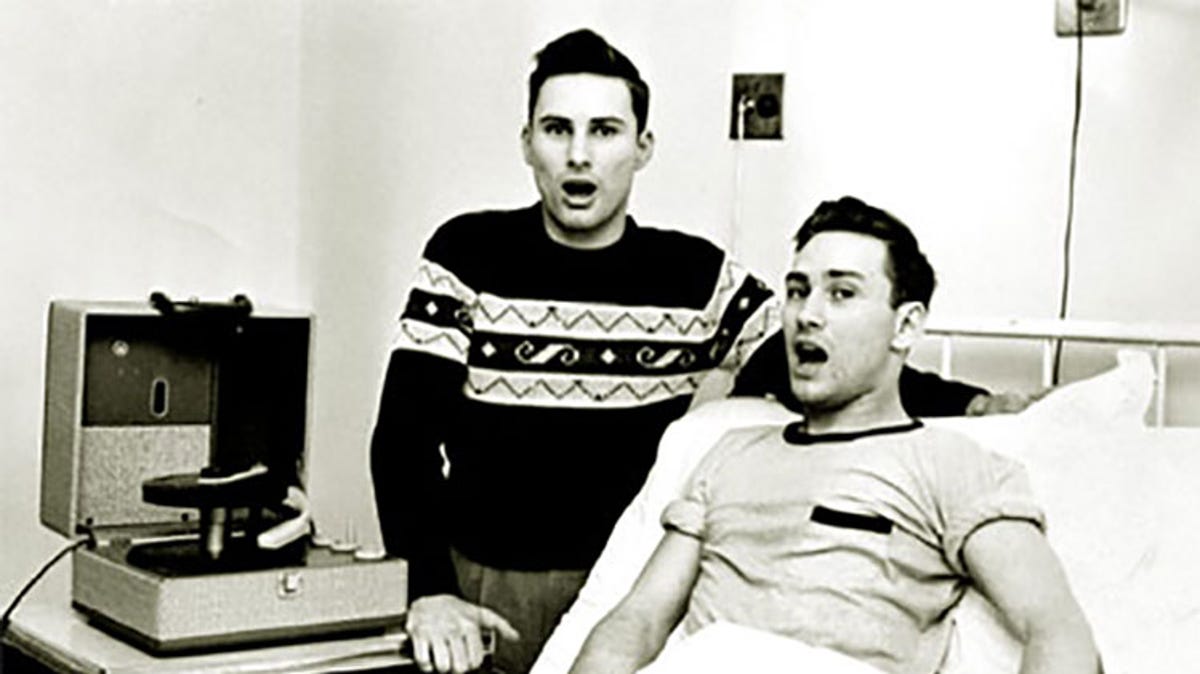
More than 70 years ago, a pair of identical twins from Rutland changed the world, taking part in the first successful human organ transplantation.
Ronald Herrick and Richard Herrick underwent 17 tests before doctors gave them the “all clear” ahead of the procedure, set to be performed by College of the Holy Cross alumnus and Milford native Dr. Joseph Murray at what was then the Peter Bent Brigham Hospital, now Brigham and Women’s Hospital.
The tests were conducted to make sure the twins were indeed identical and included fingerprinting at a local police department, where a reporter overheard why they were there.
“Suddenly the whole world was watching,” wrote Murray in a 2011 retrospective in Harvard Medicine, the magazine of Harvard Medical School. “The media quoted doctors who said the experiment was not only doomed to failure but also unethical. Those of us on the surgical team began to understand what it felt like to be a pitcher in the World Series. The difference was that, unlike that pitcher, we were about to attempt something we had never done before.”
Richard Herrick had been diagnosed with chronic nephritis as a young man and needed a new kidney in order to survive. In the 1950s organ transplantation wasn’t a new concept, but it was seen as an impossible one.
The first recorded mention of an organ transplant can be found in ancient mythology. Within the Ebers Papyrus, written around 1550 B.C., details can be found regarding skin grafting in the treatment of burns.
In 1817, a French physician named Henri Dutrochet penned a letter to the editor of the medical journal Gazette de Santé detailing a skin graft procedure that had been performed on his brother-in-law while in India.
During World War II, there are several accounts of patients receiving skin grafts, including Charles Woods, who suffered burns over 70% of his body during an aviation explosion.
During his treatment, Woods was introduced to Murray, who during the war was stationed at Valley Forge General Hospital in Pennsylvania. According to the article, “The History of Organ Transplantation” by Kristen D. Nordham and Scott Ninokawa, published in 2022 in Baylor University Medical Center Proceedings, the success of Woods’ skin graft treatment inspired Murray to pursue further into organ transplantation.
“Thus in one of my earliest experiences as a surgeon, I had reconstructed a badly damaged face and had taken an organ – in this case, skin – from one person and transplanted it to another,” Murray said in 2011. “Although I did not know it then, those two themes would come to dominate my professional life.”
Less than a decade after the war ended, the Herrick twins came to Murray for help. Because of their identical DNA, medical professionals including Murray were optimistic the surgery would not result in organ or tissue rejection.
Murray discussed his concerns ahead of the transplant and said this was the first time a doctor had “asked a healthy person to accept this magnitude of risk solely for the sake of someone else.”
Then there were the medical concerns. As Murray wrote, “Would a new, transplanted kidney need to be hooked up to a person’s lymph system in order to remain alive? No one knew.”
The operation began at 8:15 a.m. on the morning of Dec. 23, 1954, with the twins on operating tables just 50 yards from one another.
The surgery lasted one hour and 22 minutes and was a success, earning Murray the 1990 Nobel Prize in Physiology or Medicine for “discoveries concerning organ and cell transplantation in the treatment of human disease.” Murray, who shared the Nobel with Dr. E. Donnall Thomas, donated his prize money to Harvard Medical School, Brigham and Women’s Hospital, and Children’s Hospital.
A painting of the surgery hangs on a wall on the grounds of Harvard Medical School, in the first-floor lobby of the Francis A. Countway Library of Medicine.
In the aftermath, Murray conducted a dozen organ transplants between identical twins while looking at ways to fight tissue rejection in patients who are not related.
By the 1960s organ transplantation was on the rise, with several milestones including the first successful transplant between nonrelated patients and the first successful transplant from a deceased donor, both led by Murray.
“Kidney transplants seem so routine now,” Murray told The New York Times after he won the Nobel. “But the first one was like Lindbergh’s flight across the ocean.”
Despite his success, Murray never forgot his roots. He maintained ties with Holy Cross throughout his life and career. He visited the school in 2010 for the official opening of its $64 million science complex and spoke about his time at the school.
“Holy Cross gave me a very liberal education – a broad view of living – and that’s why I majored in a bachelor of arts, rather than a bachelor of science,” he said. “The courses I took in English, history, philosophy, Latin and Greek have stayed with me for the past 60-odd years. And I still remember my English professor, my physics professor, and we learned, I think, the value of living.”
Richard Herrick found love in his recovery room and ended up marrying one of the nurses who cared for him. The couple had two children.
Richard Herrick died eight years after the surgery at 31. Ronald Herrick died in 2010; he was 79.
“Their sister, Virginia, was around for a while, she was well known around town,” said Scott Davis of the Rutland Historical Society, as he stood next to a large picture of the twins. She died in April 2022.
“Not many know about the twins,” Davis added.
There are an estimated 110,000 patients in the United States waiting for an organ transplant.
T&G engagement editor Sarah Barnacle is getting to know Central Mass. by exploring some of the best places to go and things to do in Worcester County. If you have an idea or suggestion, please email sbarnacle@gannett.com.

