
August 21, 2026
2 min read
Key takeaways:
No adults with medically refractory, lung-limited, stage IV NSCLC who underwent lung transplant died in the follow-up period.
In contrast, 64.2% of adults treated with medical management alone died.
Undergoing lung transplant vs. receiving medical management alone led to greater 1-year survival in adults with medically refractory, lung-limited, stage IV non-small cell lung cancer, according to results published in JAMA.
“We are not saying lung transplant is appropriate for every patient with stage IV lung cancer,” Ankit Bharat, MD, chief of thoracic surgery and director of the Canning Thoracic Institute, said in a press release.
Data derived from Bharat A, et al. JAMA. 2026;doi:10.1001/jama.2026.8717.
“We are saying that when the cancer is rigorously proven to be confined to the lungs, when standard therapies have been exhausted, and when the lungs themselves have become the life-limiting organ, transplantation may offer a new path forward,” Bharat said.
In a prospective, single-center, registry study, Bharat and colleagues evaluated 98 adults with medically refractory, lung-limited, stage IV non-small cell lung cancer (NSCLC) who either underwent lung transplant (n = 17; median age, 61 years; 59% women) or received medical management alone (n = 81; median age, 63.4 years; 52% women) to determine how overall survival differs between the two cohorts.
Adults receiving medical management did not undergo lung transplant due to nonbiologic barriers even though they met transplant eligibility criteria, according to the study.
Researchers also assessed survival 1 year after lung transplantation between the NSCLC transplant group and 306 adults (median age, 63 years; 37% women) without cancer who underwent transplant for end-stage pulmonary disease.
Respiratory failure was present in all adults who underwent transplantation.
Median follow-up from eligibility evaluation completion through June 30, 2025, was higher in the NSCLC transplant group vs. medical management group (343 days vs. 221 days). This was also the case when comparing median follow-up times from transplant in the NSCLC transplant group vs. the transplant group without cancer (323 days vs. 200 days), according to the study.
Among those who underwent transplantation, both the group with cancer and the group without cancer had comparable outcomes following the operation, including:
median ICU stay (7 days vs. 6 days);
median hospital stay (14 days vs. 16 days);
median mechanical ventilation duration (both 2 days);
venovenous extracorporeal membrane oxygenation use (6% vs. 11%);
acute kidney injury (35% vs. 47%);
dialysis (0 vs. 3%);
stroke (6% vs. 3%);
grade 3 primary graft dysfunction (24% vs. 13%);
acute cellular rejection (6% vs. 15%); and
antibody-mediated rejection (0 vs. 4%).
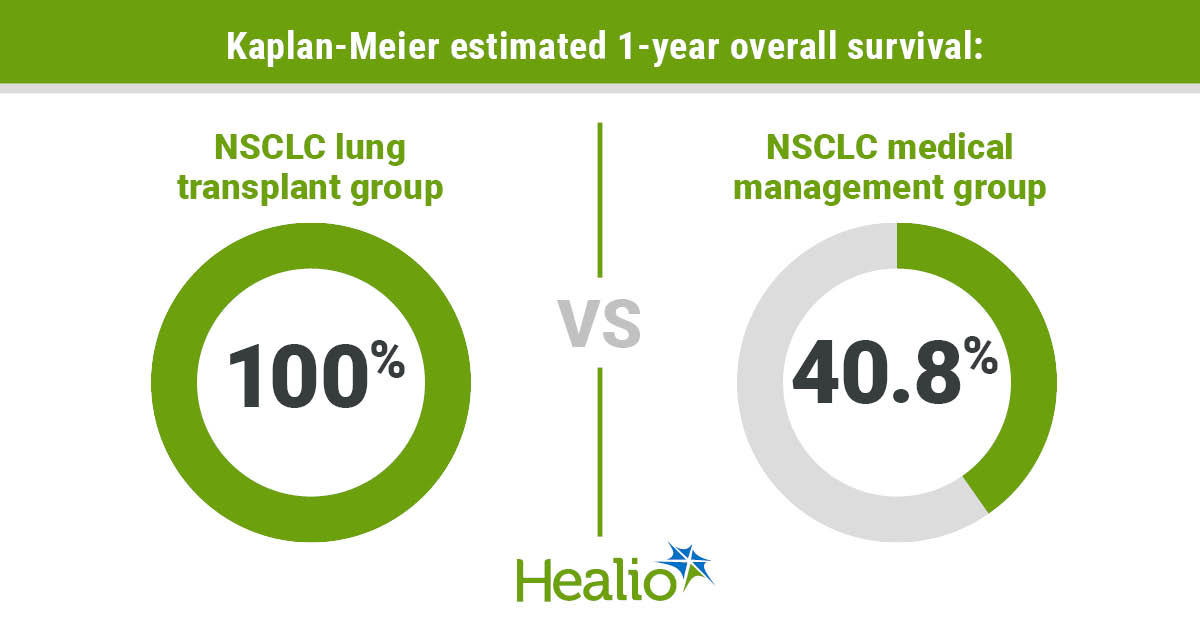
Among those with NSCLC, no adults who underwent lung transplant died in the follow-up period, whereas 52 adults (64.2%) treated with medical management alone died. This translated to a higher Kaplan-Meier estimated 1-year overall survival in the transplant group (100% vs. 40.8%; absolute difference, 59.2 percentage points; 95% CI, 46.2-71.7).
Higher overall survival was also observed by day 500 in the transplant vs. medical management group (100% vs. 17.5%), according to the study.
Researchers found that the NSCLC transplant group continued to have greater survival at 1 year after transplantation when compared with the transplant group without cancer (100% vs. 88.1%; absolute difference, 11.9 percentage points; 90% CI, 9.1-15.5).
While following those with NSCLC who underwent transplant, clinically evident recurrence or progression of NSCLC was reported in four patients. According to the release, local and systemic therapies were given to these patients.
The NSCLC transplant group had two deaths when checked on Jan. 31, 2026.
“Longer follow-up is required to define the durability of disease control and the frequency of late recurrence,” Bharat and colleagues wrote.

Ask a clinical question and tap into Healio AI’s knowledge base.
PubMed, enrolling/recruiting trials, guidelines
Clinical Guidance, Healio CME, FDA news
Healio’s exclusive daily news coverage of clinical data
Learn more

